Monday, 1st October, 1917

Nocturnal ramble with my two co-dabblers to Fleet.  We chatted for a time with Mr. & Mrs. Colourman Artist, who took us into their houses at the back of the shop and showed us a lot of paintings and a portfolio, always an interesting jumble.

Have I told you about the Hieland fire-eater? – a brawny old Scot with a walrus moustache, about 60 years of age.  He goes to bunk early (usually with his bare feet protruding) and flies into appalling rages if disturbed; gets half out of bed with eyes blazing and “offers out” every man in the hut in the most picturesque (adjectival) Scotch.  He has been all through the wars – as wild as the ocean wave is Donald.
Sunday 30th September (1917)

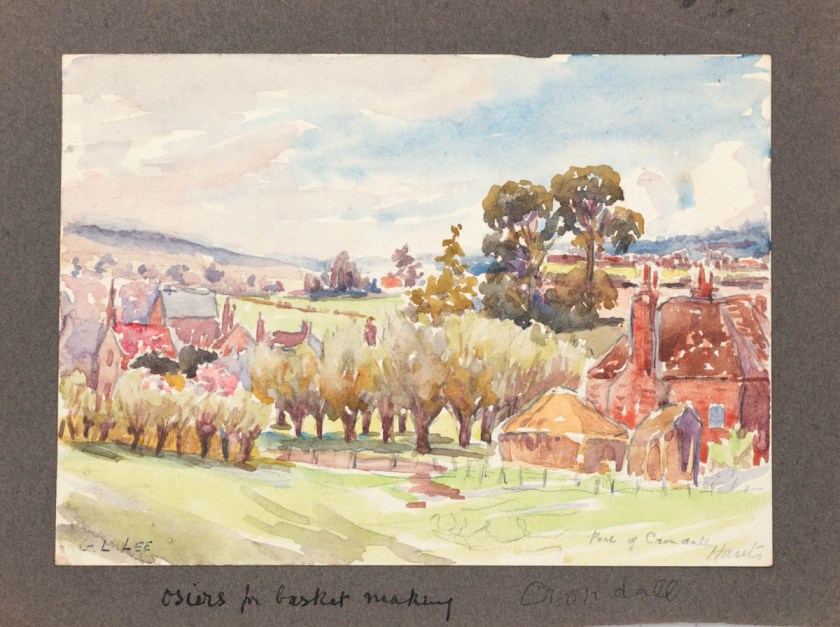
After I got into bunk last night and noticed the moonlight shining brightly through the window, it occurred to me that it might be possible to read by it – whereat I hawked your letters out, getting through the whole lot in about half an hour.  Just finished tea which we had to the accompaniment of the old Church bell chiming for the Harvest Festival, and what a glorious night for it, with the full moon peering down through the elms and limes!  J & I did sketches, showing rows of pollard willows in the foreground.  That is an ‘osier bed and there is a basket-making establishment there.

I made myself disliked by pushing my hat back and blundering off over hill and dale reading your letters out in the good old fresh air.  By the time I had finished them, and come back to the (English) world, we were somewhere within reach of the road to Odiham.  Having glutted ourselves with art, the inner man began to assert himself, so we bethought ourselves where might be the nearest refectory and lo! Mrs. Crondall’s was it, so “Here we are, here we are, here we are again!”.

[Sketch by Lincoln Lee, Osier bed, September 1917]

Lincoln Lee - Osier bed - 30 September 1917

Saturday 29th September (1917)

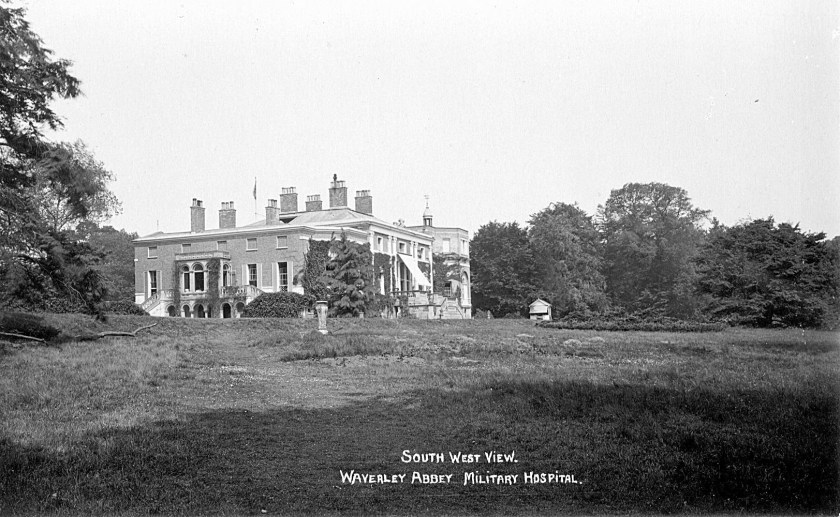
In the afternoon to the famous Waverley Abbey.  The last half mile was unutterably beautiful, a river, ponds, weirs, lovely lodges covered with glowing virginia creeper and ivy, and all enclosed by great masses of towering trees, some still green, others with the autumn tints in full swing.  The ruins of the old Abbey, once one of the largest in England which dates to the 11th century, were typical, but the grounds and woods, avenues, streams and lakes which are around and about it, are, to my mind, its chief attraction.  We had a talk with the matron of the present building, now a hospital, who was very pleasant and interested in our sketching.

[Waverely Abbey Military Hospital, image from here]

Exterior of Waverley Abbey

Friday (28 September 1917)

We three daublers made off after tea and effected what purported to be sunset effects in water-colour.  We walked to Fleet and visited our now well-known colour-shop.  Finished our Fleet episode by a repetition of that plebeianism, fish and chips from newspaper bags in the tell-tale moonshine.

24th September (1917)

I have been trying to remember some ludicrous mispronunciations by the men last night, one was Robing Hood, another was rhetoric used, very pompously, i.e., a certain play was very rhetoric.  The man addressed asked: How the blanket he could be expected to know the meaning of that?  There is a half-Italian here named Romano, but all the Sergeants call his name out as Romeo.  Another’s name is Sugrue, which gets much mauling, the latest being Sorgee.  Satterthwaite baffles them all.

Sunday, 7.30 p.m. (23rd September 1917)

(At Farnham Soldiers’ Home)  Out side 11 a.m. roaming around the countryside.  Imagine our feeling when after putting on the eggs we had ordered, Mrs. Crondall proudly marched in with a whole apple pie.  Lunch over we proceeded through the village slaying en route a tiny snake wriggling across the road.  You may think us pretty mad – always going in much the same directions, but for myself I prefer to get to know one place well rather than glimpses of several – one gets a kind of affection and feeling of proprietorship towards a village like Crondall.

22nd September (1917)

Last night in the pub at Fleet we had an amusing conversation with an old horny and almost inarticulate villager.  His voice was dry like crackling twigs and he had a face like an old bird all covered with grey stubble.  He cracked of things long ago, when there was only one “Poob” in Aldershot and told us what he considered the salient event of his youth – mostly an unintelligible story about a stubborn donkey.  They are a rough lot in this hut, but don’t pretend to be anything else.  Yesterday at physical jerks I was as R. would say “affected in the risible”.  At halftime we do various capers, intended I suppose to relax the muscles, in a ring bent double, and the instructor goes round and hands a strap surreptitiously to anyone, who immediately belabours his right-hand neighbour, continuing all round the ring until he completes the circuit.  Well, I had the strap given to me and on commencing to attack found my victim to be a very hard faced man (afterwards killed) of about 40, with a drooping lip-weed, who squared round and refused to flee.  On my letting out with the strap he countered by a clout with one hand and a kick in the rear with the other foot; result hilarity, and disorganisation of class.  Accompanied by R. and one Jull,* from Hamilton who paints, after lunch (at which I sampled my first Bloater), we sauntered down the road to Pilcot.  Officer with a very Tory accent accompanied by two ladies came up and asked to see our sketches, which we had to produce.  He and his sister bestowed unqualified praise on them all, evidently being easily pleased.  As we were an hungered and there was nowhere else to get sup or bite, what did we?  Why, what other than back to Crondall and eat “Mrs. Crondall” out of house and home?

[*Ted Jull, who remained a friend of Lincoln’s after the war].

21st September (1917)

The idiots that be, have made us change huts again and I am with a different set of chaps from whom I know.  However there is a certain interest in making their acquaintance.  Returned after some light refreshment out beneath the twinkling but unknown stars, to find half the camp in its usual state of pay-night inebriety – they call it being stunned.  I enjoy the vagaries of boozed soldiers, they usually get happy tight.

[“The spirit of the troops is excellent”, cartoon of boozed NZ artilleryman by H. P. Watson, copy supplied by Nigel Robson with thanks]

The Spirit of the Troops


18th to 20th September (1917)

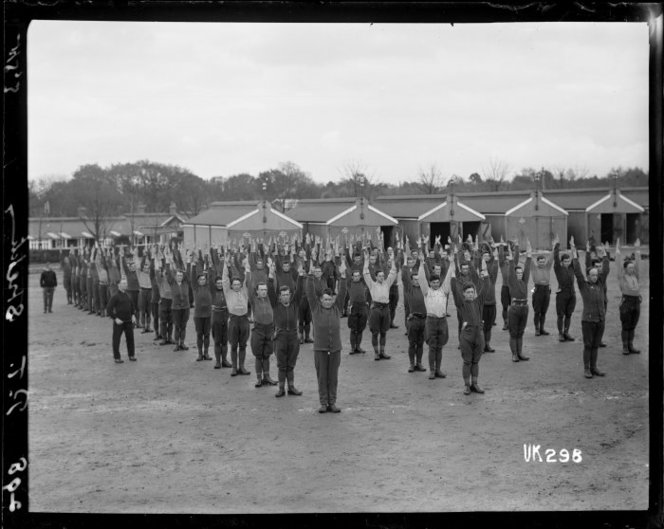
Just seen a lovely triangular pillow fight between two bald-headed men and a thin chap.  Physical drill at 2 p.m. is a disgusting innovation and gives us all indigestion.  R. materialised with hands-full of boot protectors, whereat we stole, boots in hand to the parson’s hut, where a cobbler’s last was secreted.  There we made the walls shake belabouring our nether gear with the remains of a poker, then strode iron-shod into the night – to what Ultima Thule? what “wished and glorious metropolis”?* – Crondall.  The air was cool and clear but nothing to the beer.  You will be surmising that we were over-bibulous but no – 3 half pints of the best bitter and all the fitter, returned we to durance vile.  At one stage we bellowed Up from Somerset to the alley’s titanic (not of cypress but elms) and probably to the astonishment of wakeful cottagers.  The landlady of the pub at Crondall gave me a farthing.

[Physical training exercises at the New Zealand Artillery camp, Ewshot, 1/2-014102-G, National Library]

014102.tif

* The phrase “Wished and glorious metropolis” may be from “Marpessa”, by Stephen Phillips.

Or since thou art a woman, thou shalt have

More tender tasks; to steal upon the sea,

A long expected bliss to tossing men.

Or build upon the evening sky some wished

And glorious metropolis of cloud.