Many happy returns! It is very hard to realise that we have been married for ten years, and here I am off to fight Germans with a lot of boys.
8 p.m. In bed. The Southern Cross will apparently remain visible until we pass the equator. The moon is waning for the second time during our voyage but the black bulks of the other ships can be made out prowling in the starlight. Good night.
Some girls in a boat caused a diversion by coming alongside and taking letters from the men (lowered from the deck by means of puttees etc) until shooed off. This is a magnificent Bay. On my right is the great Table Mountain around whose base the town clusters. In front, sandy beach from which a plane sweeps about 40 miles to a high ragged range of mountains (The Drachenbergs?) To the left the beach runs on as far as the eye can follow, flanked by rolling hills dotted with farms. These continue round to the outer horn of the bay, apparently 60 or 70 miles away, where the ocean makes up and completes the circle, save for a small low island about 5 or 6 miles out opposite the port which is I understand, a Leper sanatorium. The sun is blazing and hot-looking clouds lie around the horizon and over the brow of the mountain and this is winter!
We are off! Put out to sea with bands playing; one of a convoy of eight large steamers sailing in line about ¼ mile apart. Table Mountain is shrinking in the distance and we feel again the familiar roll of the ocean. Later the vessels lined up two and two, with the escorting ship (a converted cruiser) in the rear.
Night: The sea is highly phosphorescent, and the bow wave of the ship seems to be composed of scintillating diamonds. From the luminous darkness an army of porpoises, careering like long-tailed comets through the sparkling water, have been rushing up to the bow, where they double on their tracks, piloting the ship for miles and providing the best pyrotechnic display I have ever seen.
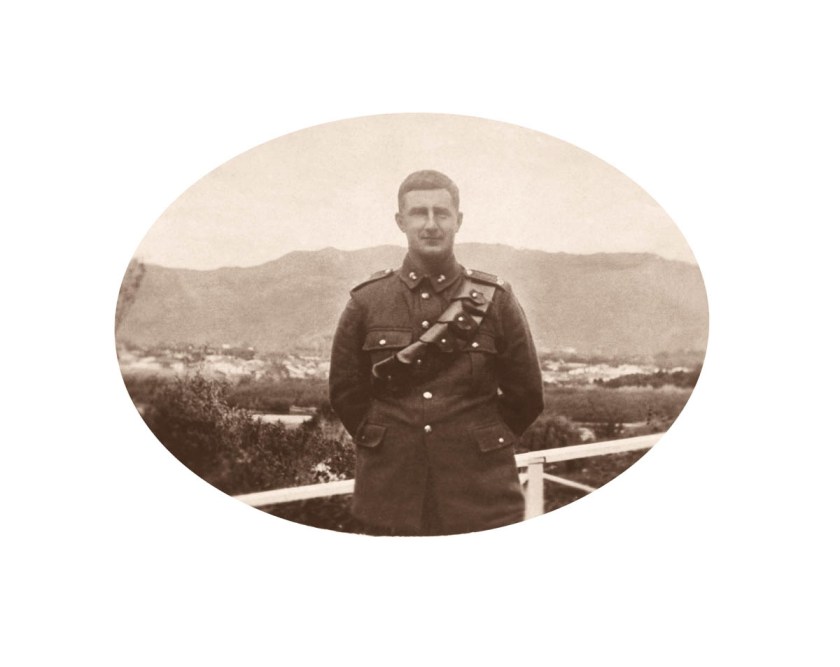
Gunner Lincoln Lee [Now better identified as from The Hutt, looking eastwards, across the Hutt River. Photo thus out of sequence!]
More and more ships have arrived including a man-o-war and an auxiliary cruiser. As one of the chaps remarked, “Germany rules the waves all right!”.
This afternoon we had boxing instead of drill. Most of the bouts were mere punching matches. I got a clout on the head that made the world go round for a while, but my opponent reckons he saw many varieties of stars also. A powerful young farmer; when I asked why he hit so hard apologised and said once started he couldn’t help it, we became friends.
The harbour is filling with ships. A naval gun is now mounted in the stern and we gunners are to man it under the supervision of two Naval Reserve gunners. We will have continuous shifts of 4 hours on and 8 hours off throughout the rest of the voyage.
Alas – our boat went out into the stream this morning, and is now awaiting convoy. Tobacco, railway fares, fruit in season, servants and labour, are cheap, meals, food stuffs etc. very dear, also firewood, but salaries are correspondingly higher. I had on occasions a glass of brandy with K. and have never tasted spirit which I cared so much about. The reason is, here distillers are under compulsion to make brandy out of wine. The city and suburbs are situated at the root or isthmus of a long narrow peninsular dividing two large bays (see atlas). The water in the bay on which the city stands is cold, but that of the other bay is much warmer and its shores are consequently the favourite watering places. The higher ground is stony and rocky and of a reddish volcanic appearance, though not scoriac, and is thinly coated with a stunted kind of heath and scattered hardy-looking trees. On the low country there is grass and the soil is sandy though good for certain purposes, such as growing vegetables. What with the heathers, of which there are numerous varieties, and all the other flowering things, it must be a wonderful sight in spring.
Gloom entirely dispelled. Have been on leave yesterday and today from noon till 11 p.m. in company of Warwick Wilson my lifelong friend. On Friday, after triumphal march through the city, took a tram ride over one spur of Table Mountain to a pretty seaside resort, Camp Bay [Camps Bay], and given afternoon tea free: returned to city by another route. The beach was of glistening white granite sand, pounded from great rocks which act as the buttresses of a continent. Thousands of feet above tower the rugged peaks of the sea-following ranges. On our return looked up Mr. Ker, a tall cadaverous chap with big prominent eyes, a widower, a real good sort. We had dinner and spent the evening with him. Today he has insisted on entertaining us all day. I call him “the soldiers friend”. He seems to take a genuine delight in giving New Zealanders a good time. We went Friday, to another beautiful seaside suburb, Muissenberg [Muizenberg], with grand view of the sea and mountains. To dinner with K and spent the evening with him again.
We are unit for duty, but by good luck I missed guard, but poor W. struck it. We had a church parade, attended by the Governor of the Colony and his lady, at the Cathedral; a fine building of granite with very beautiful blue glass windows. Went up to K’s diggings and spent the whole day with him and his little daughter, of about eleven years, who held me by the hand and prattled throughout the day. We walked to Camp Bay and visited the monument to Cecil Rhodes, an imposing structure in granite, with huge pillars and bronze statues, situated in a magnificent park. Had afternoon tea up there, then walked down, visiting en passant a zoo, and subsequently leaving the little girl at her boarding school; then returned with K. and smoked and yarned with him and his friend. This town is full of interest and fine whites, yellows and reds of the buildings and the gay colours of the natives’ clothes, delight the eye.
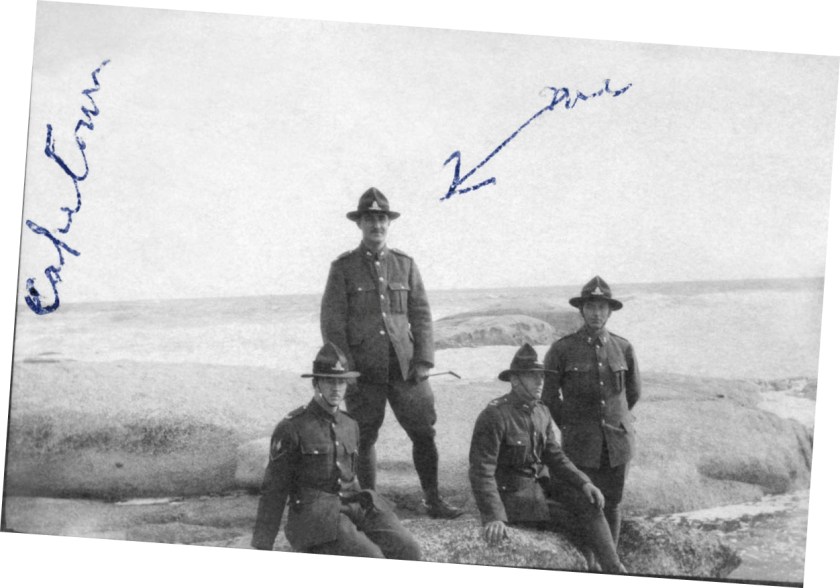
Lincoln and others, potentially taken at Camps Bay, Capetown
After prodigious delays we were taken for a short route march through part of the town, the main objects of interest were the well-built houses with plenty of white about them and usually slate roofs; good roads, thin horses, mules, donkeys; and blacks in all variety of disreputable European clothing. The white people of means all appear to have retinues of natives servants. Although approaching winter the weather is warm and sunny. It must be extremely warm in summer. Portuguese ships are in port, so I have seen some of that race too – they aren’t bad looking chaps though I wouldn’t vouch for their not being bad. What trees I have noticed are mostly familiar, gums, pepper trees, pines, banana palms, and a tropical tree of which there is a specimen in Albert Park. Two troopships that left N.Z. after us have arrived. Interesting to watch the blacks coaling the vessels at night, like so many devils; black skin, black clothes, gleaming white teeth and eyes. The deck is crowded with disconsolate men gazing wistfully at the shore.
Here we are, on a perfect day within about 20 miles of land – porpoises in thousands playing in the shining sea and all sorts of birds flying about and settling on the water, the Gannets diving after fish. Anchored in the stream at about 3 p.m. The scenery is very rugged and striking. Did a few pencil sketches of outline of mountains.
Nearing port (Capetown). Our trip must constitute something of a record of a non-stop run without sighting land or even another ship. Given scalding hot buckets of fresh water this morning and bathed ourselves – mine nearly took the skin off. Also got our identification disks, “cold meat tickets” as the men call them. Sailors are getting the hawsers out ready for berthing. Every-one excited at prospect of reaching land and hopes of leave.
When last I left you I was anticipating a pleasant morning’s potato and onion peeling, but my hopes were frustrated by the substitution in a later edict of “Butchers Shop” for “Cook House”. The work did not take above a couple of hours, but — well you know how fond I am of raw meat and scrubbing greasy floors. I often wonder what some of the perkier individuals would look like were they asked to put their patriotism to the test by, say, carrying half a dozen carcasses of mutton out of the nether slums of the ship, up a precipitous stairway and into the evil-smelling den of the fleshers. Pouff! There is now a “Submarine guard”, armed men posted round the fore-parts of the vessel looking out for submarines or mines. It doesn’t make us nervous, only blasphemous at the prospect of more frequent duty. It is difficult to see what use the rifles would be. Received wireless indicating that America seems to be on the move towards joining the Allies. You would have been amused to see me last night yelling such devotional exercises as “In the sweet bye and bye” – “When the roll is called up younger” at a service held by the Methodist Chaplain.

 Walk March