25th August (1918)

Bivouaced in the open on a recent battlefield.  When I had written the last page in bed a sergeant came in and roused us all out bag and baggage and we’ve been going ever since, advancing from one position to another, carrying ammunition all over the place.  The scene of the recent advance is striking and terrible.  The ground is thick with shell-holes, wrecked ‘planes, tanks, armoured cars, and all the paraphernalia of war, and the dead are still lying about, some in singularly life-like attitudes – the hot weather already playing its part and producing diabolical results.  The country is rolling, with some narrow gullies on whose ridges are the remnants of machine gun redoubts etc.  Last night we lay in the open fields and the dew was so heavy that it wet my horse-blanket though.  Got a good sleep in spite of enormous bombardments.  In the afternoon several daring Hun fliers came over quite low.  How they escaped from our machine guns, rattling in all quarters, mystifies me.  The scene, especially at sunset and by moonlight, of moving masses of artillery, the din of gunfire, bursting shells, bombs, etc. and the spasmodic gun-flashes stabbing up at the sky, created an effect hard to even faintly describe.  The fact however it is an advance and not a retreat makes one take it more cheerfully – the trumpet blows!
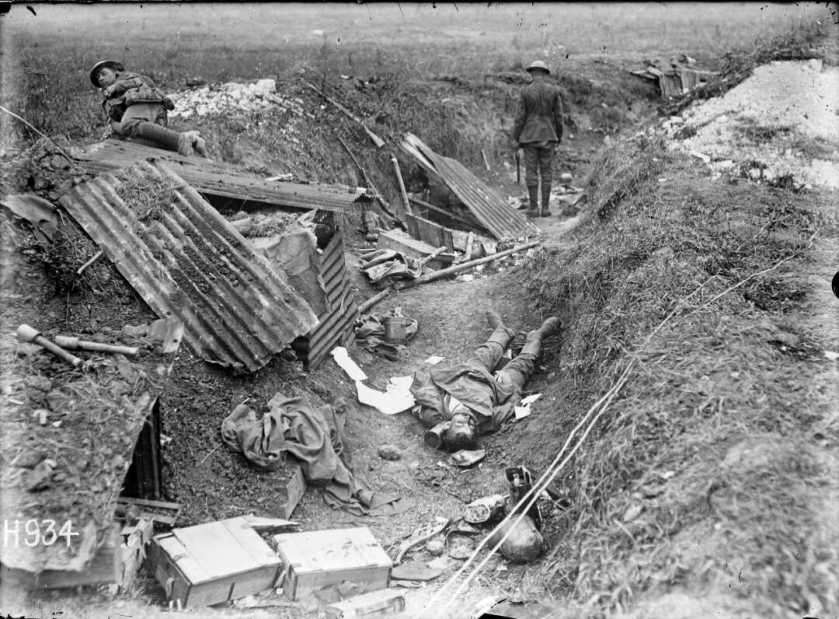
nlnzimage 1-2 013508-G Captured German MG position, Grevillers, 24 Aug 1918

[Image: A German machine gun position photographed just after its capture by New Zealand troops during World War I. Shows a New Zealander inspecting the trench in which a dead German soldier lays. Sheets of iron and pieces of timber are strewn around the nearby dugout. Two stick hand grenades are visible in the foreground. Photograph taken Grevillers 24 August 1918 by Henry Armytage Sanders. Alexander Turnbull Library, Wellington. Ref: 1/2-013508-G]
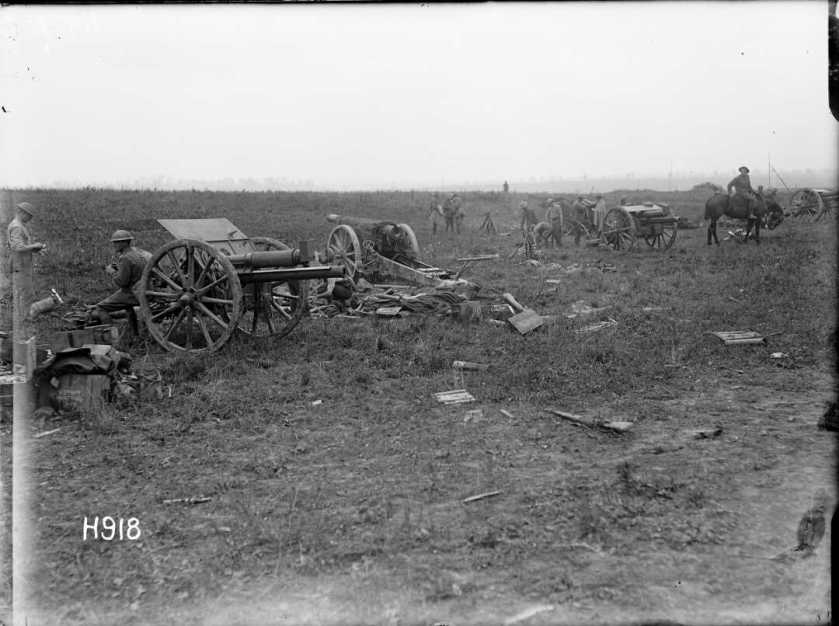
nlnzimage 1-2 013494-G Captured German artillery, Grevillers, 24 Aug 1918

[Image: Guns in a captured German battery at Grevillers, France, during World War I. Image taken by Henry Armytage Sanders, 24 August, 1918. Alexander Turnbull Library, Wellington. Ref: 1/2-013494-G]
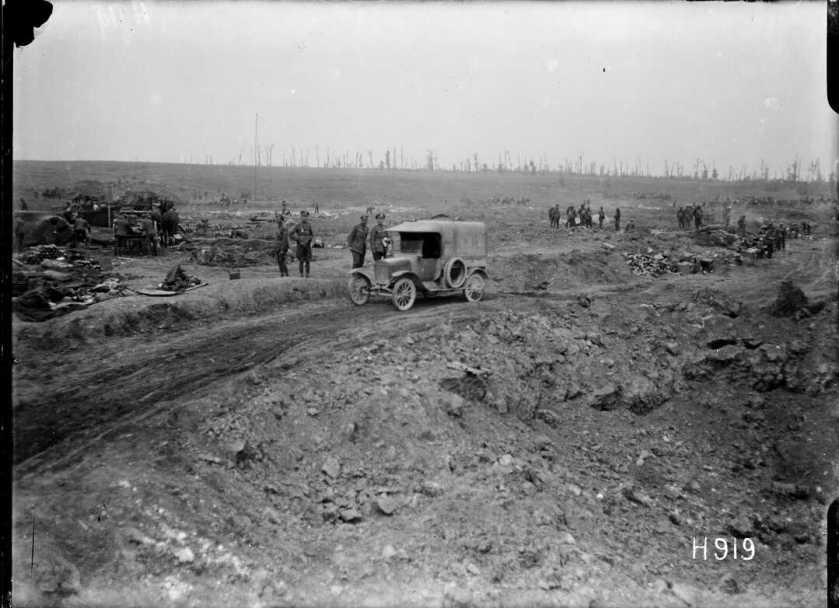
nlnzimage 1-2 013495-G Motor car passing a huge shell hole in captured ground, Grevillers, 24 Aug 1918

[Image: A motor car travelling along an uneven dirt road passes a huge shell hole in captured ground during World War I. Small groups of soldiers are visible in the background. Tree stumps appear on the horizon. Photograph taken near Grevillers, France, on 24 August 1918 by Henry Armytage Sanders. Alexander Turnbull Library, Wellington. Ref: 1/2-013495-G]
23rd August (1918)

That train was a long while arriving.  Then we were laconically informed that we would leave at 6.p.m.  The heat was pitiless and we were at a huge railway centre.  (Candas, with no trees in sight).  Found a boiler of hot water, made tea and drank it by the quart.  The place was on high ground, huge aerodromes in the vicinity, also large aeroplane works where spare parts manufactured and machines repaired.  The next sight and a very satisfactory one was of long trains packed with Hun prisoners who looked pretty cheerful, as if a load had been taken off their minds.  They had bully beef and we spent some time opening their tins as they had no knives.  Another by no means discouraging sight was the number of Americans waiting about in reserve.  It was after 9 p.m. when we completed the few miles to our destination.  With my entire kit and blankets I had to march 3 to 4 miles – feeling as weak as a kitten.  In 10 minutes all my clothes were soaked through with perspiration.  Just managed to stick it – had a huge drink of cold tea and cool stew and snatched a few hours sleep, disrupted by repeated bombing.  Eventually found our wagon lines in the same old place – they have not been able to move them until water supplies are obtained forward.  As the Hun has been pushed back about 5 miles it means that we have at present an enormous “carry” up to our guns.  I was gleefully wading into my mail when alas! every man jack had to harness up and away.  Drove what seemed an endless distance right through the Hun’s old lines where many gruesome mementoes were visible (or smellable), finishing with a very rough ride across shell-torn country to our latest gun position.  Shells bursting none too far off.

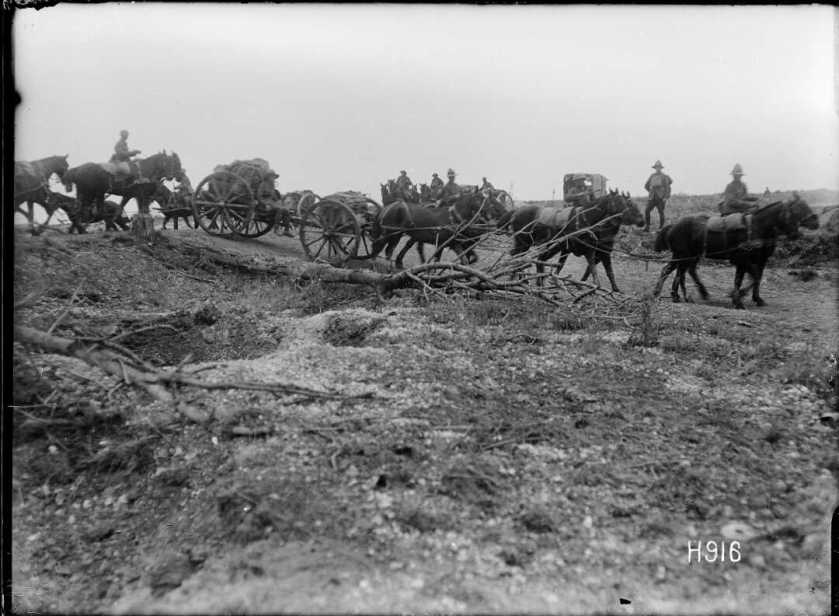
nlnzimage 1-2 013492-G NZ Battery advancing, 24 Aug 1918

[Image: A New Zealand Battery moving into a forward position during World War I in France. Shows teams of horses pulling wagons of equipment over ground pitted with shell holes. Photograph taken Grevillers 24 August 1918 by Henry Armytage Sanders. Alexander Turnbull Library, Wellington. Ref: 1/2-013492-G]

21st August (1918)

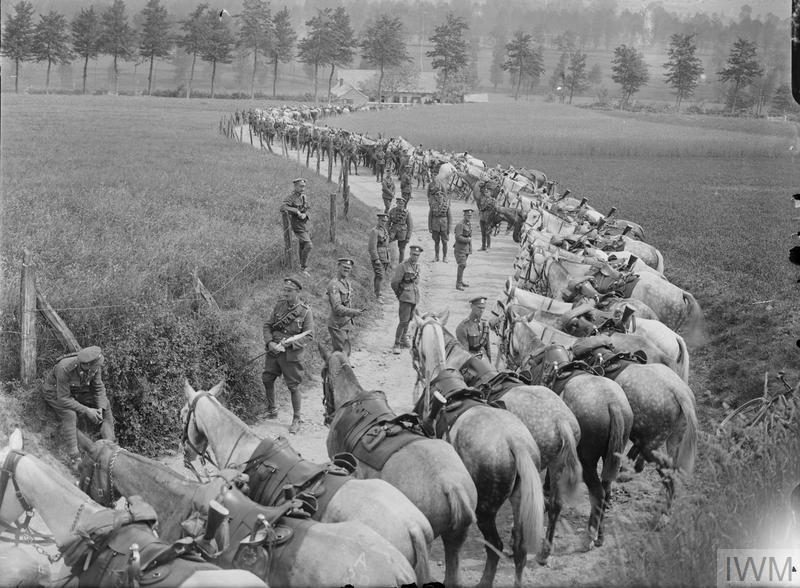
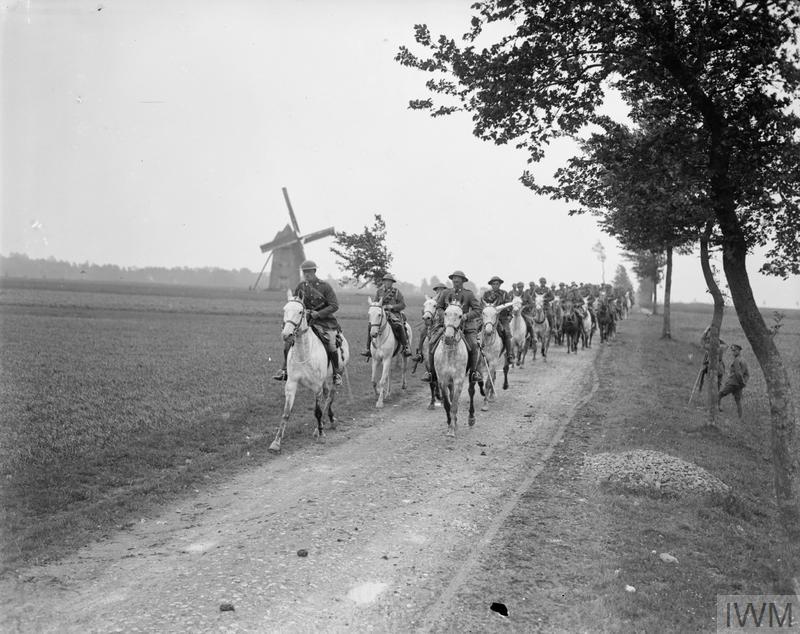
During the night vast bodies of cavalry trotted past the camp, including the famous Scots Greys.  There is something doing on the front.*

A digger entertained the half-credulous tommies with amazing stories of the Moa – how the whole ground trembles when they, from a great height, drop their 4 ft. long eggs, and the Katipo Spider, as large as the palm of the hand, whose bite means death in 10 seconds – they spring at you from almost any distance, and are so hard that a man has been known to break a cricket bat trying to kill one – How the Maori, in canoes of enormous length, leap over fallen trees lying across streams and the buffaloes sharpen their horns on trees and are purposely irritated by trained men so that they are induced to actually cut the trees down and save felling them.  The large Waikato youth with golden curls has dubbed me “King Mahuta”.

In the gloaming took farewell stroll by the river and watched the late harvesters building armies of stooks on the shaven fields, whilst the sun sank over the distant town and the moon rose above the trees.

[* “There is something doing on the front”.  Indeed there was.  From the New Zealand History website: “On 21 August, the British Third Army (including the New Zealand Division) attacked along a 15-km front north of Amiens, pushing back the German line and driving toward Bapaume. The New Zealand Division played a support role for the first few days of the battle, then moved into the vanguard of IV Corps’ advance. On 24 August it captured Grévillers, Loupart Wood and Biefvillers. Operating now in ground that had not been shelled, with villages, farms and forests largely intact, the New Zealanders revelled, and excelled, in the new conditions of open warfare.”]

IWM (Q 8952) Royal Scots Greys riding their horses on a road at Brimeux, 25 May 1918

[Image: Men of the Royal Scots Greys riding their horses on a road at Brimeux, 25 May 1918.  A windmill can be seen across the fields behind them. IWM (Q 8952)]

IWM (Q 3269) Royal Scots Greys resting by the road near Montreuil, 8 May 1918

[Image: Royal Scots Greys resting by the road near Montreuil, 8 May 1918. IWM (Q 3269)]

20th August (1918)

Don’t seem to be able to get away from this place – told a “Yank” Dr. I was all right – felt my pulse awhile and said “I guess you’ll stay another day”.  Alphonso seems to be getting worse instead of better – the bacon dip disagrees with him.  He has given up breaking into song – strange, high, inarticulate moanings – still it was a song in the making.

19th August (1918)

Large gangs of Hun prisoners have been working on the railway line – a mixed lot.  One chap of about 45 years took my fancy; he wore a child’s straw hat and a long walrus “mow” of similar material.  Some of them are certainly very young, but no younger than many of the “tommies” and they average a heavier build than the latter.  A soft-toned bell was calling the villages to an evening service, the long-robed priest standing in the doorway.  We looked in.  The interior was plain and neat.

18th August (1918)

My penultimate breakfast of bread and dip gastronomically accommodated I sit and face the future with self-righteous fortitude.  But where is my mail?  Alphonso sits and polishes his buttons and shines his boots like a good soldier.  I do neither, being after all, a “N.Zedder.”  Having now read nothing of importance for a couple of years I find my mind growing curiously bankrupt.  Yet, if one’s mind can be maintained only by assimilating the ideas of others, how is it to gain originality? (Echo – of some similar phenomenon – answers – “How?”).

17th August (1918)

Breakfasted upon bread dipped in bacon fat and fragment of the real fried article.  Last evening Alphonso and I roamed the riverside, where he wrote to his missus, as he termed his lady-love, and I did a sketch.  You could see miles of cultivated country, rolling hill and valley, and hardly one farm-house.  The farm people here keep to the towns, as in other parts they congregate in the villages.

That fictitious temperature, still haunts me.  The C.O. today gravely underlined it and said “give him another day”.  The indefinable sensation of having finished with a certain phase of existence steals over me and I feel that it is time for the next act to open.

Sunday, 16th August (1918)

After tea I accompanied “Alphonso” to the town.  Alphonso, so christened by a big Waikato boy, is a nice youth with a Lancashire brogue.  When we came in view of the church I ventured to draw it and, very soon, a dozen youngsters crowded round and gasped “Dessin! L’eglise!”.  Alphonso was much interested and wants to come sketching and try his own hand.  We poked about the town and then ascended to the church, which we found open and empty.  It struck me as a being a fine structure both within and without, built of stone which time has mellowed into delicate greys and blues.  The triple altars seemed very fine and the stained glass windows above them particularly rich.  There are also several large figures of Christ.  Half obliterated mural carvings and inscriptions over the tombs of medieval warriors showed the great age of the building.  I am now “ordinary” and “conval” again.  Alphonso on the other hand, though outwardly presentable has given evidence of the concealment of certain “cells” that may lengthen his incarceration.

The Hun dropped some very big bombs over Doulens way last night.  There is an aerodrome hereabouts, that he often tried to attack, but he is always met with such swarms of our big wasps that he has to bolt for it – (By the way a wasp stung me on the elbow the other day and I had an egg there for a few hours).

14th August (1918)

The orderly this morning dazzled the doctor with science.  He apparently gave us all good high temperatures, with the result that we were told to carry on as at present.  Mine attained the fictitious altitude of 99.6˚.  Tea over, four of us strolled to the town, Auxi-le-chateau, by way of the river-side bank giving us shelter from the afternoon sun and the fields of rich gold, green and yellow, spreading out on either hand.  As we neared the town we gained picturesque views of it.  It possessed a handsome church or cathedral built high on a hillock, its foundations being thus about level with the roofs, red and grey, of the town buildings, over which it seems to keep watch and ward.  The town itself is a charming, neat, clean-swept little place of, I should say, a peacetime population of two or three thousands.  We visited many shops and bought a few articles.  Most of the shops were in charge of women, polite, dainty and wonderfully neatly dressed.

We wandered slowly back in the sunset, everything looking like fairyland, but we felt like old, old men who had spent their last energies in a hundred mile march, and just had enough strength to get back to hospital.