
Had tethered my mules and sat down with a sigh of satisfaction only to realise that I had planted my bare arm in a bush of stinging nettles. This is nerve wracking.
Author: walkmarch
23rd May (1918)
They are making a cricket pitch at the back of the camp and have adopted a cunning method of getting it hard, to wit, by making us ride over it every time we go to or from water. In one day it has been stamped quite firm. Tried Rangatira over the jumps the battery next door have put up.* He jumps strongly and well, but much prefers to dodge it. Apparently a mule is constitutionally unable to gallop at his top speed. Whenever I have tried one at it he has put his head right down until he seems in danger of going head over heels. Whilst prancing about I suddenly caught sight of Jull standing by watching the performance. He tells me R. had been peppered all over and is in a Belgian Hospital.
* Although not referred to by Lincoln, the images below show a horse show held by the New Zealand Infantry Brigade on 20 May 1918. Seemingly horse (although perhaps not mules!) jumping was a popular recreational occupation at this time.

[Image: A general view of the show ring at the New Zealand Infantry Brigade horse show, held in Vaucelles, France, during World War I. Spectators are looking towards the ring where an event is in progress. Photograph taken 20 May 1918 by Henry Armytage Sanders. Alexander Turnbull Library, Wellington. Ref: 1/2-013234-G]

[Image: The winner of the officers’ jumping event at the New Zealand Infantry Brigade horse show, Vaucelles, World War I. Shows the judges with riders and mounts. Photograph taken 20 May 1918 by Henry Armytage Sanders. Alexander Turnbull Library, Wellington. Ref: 1/2-013228-G]
Sunday, 19th May (1918)
My 34th birthday. A cool breeze playing over the land. Scatty had the effrontery to shy at a donkey led by the oldest and most crumpled-up man I’ve ever seen, not recognising her own half-brother. Water is a problem in these districts. It is quite a sight, the pairs lining the road for kilometres, waiting their turn. Today you can smell the sea in the wind, the hawthorn is in the height of blossom, poppies are showing up amidst the corn and the meadows are sprinkled with butter cups and millions of misguided human beings are occupied with the problem of mutual murder. In the hazy light-blue sky, aeroplanes are singing like hornets. Set off to a village about 4 miles away where a stream has been damned for bathing. Rangatira makes a fine little hack and I should like to acquire him apres la guerre. How would I look trotting up Queen St. on a mule? At the pond were a number of Yankees and it was interesting to hear their conversation and study their types, mostly big men.
16th & 17th May (1918)
The grass is a seething mass of insect life. I tethered my mules to a partially buried wire and did a rough sketch of some trees. The next time I looked they were stampeding, maddened with terror by an old sack, pulled out of the ground with the wire and now leaping and bounding after them like the Mullish Nemesis. After they had become entangled in the chains and violently thrown by and then repeated the stampede, I managed to secure them, crestfallen, somewhat scratched about and still eyeing with dread and apprehension the now motionless Flying-Sack-Demon.
The Gamblers take not the slightest notice of the weather, the war, or other phenomena, absorbed in the spin of 2 coppers.
Magnificent beetles and other insects, spawned from the warm soil, are making clumsy efforts at flight. One enormous fellow after setting different-hued sails, only managed a six-inch flop. Spiders and other leggy individuals are running steeple-chases over my puttees and strides.
14th May (1918)
Great fun this afternoon watering. On reaching our troughs found them out of order and had to go a mile and a half away. The sergeant in charge of us was a sport and in defiance of all rules and regulations took us across country at a hand-gallop. About 15 colonels set up a hue and cry and took the names of battery etc – (Bai jove!). The sergeant is a fine chap – absolutely fearless – holds Military Cross, Serbian Medal and what not. When he gets them he shoves them in his pocket and says “Oh well, I suppose my mother will be pleased”. I have been re-reading Shelley to be awakened out of the wonder-world of his creation into the vile world of hate and murder which has evolved from those types which he detested. Been growing strong carting ammunition. A battery of 6 inches let fly right across the road, scaring us and our donks into the middle of next week.
13th May (1918)
During grazing one horse got so entangled in his tether as to be thrown – amusing to see him make the best of things by instantly resuming his repast in a recumbent position.
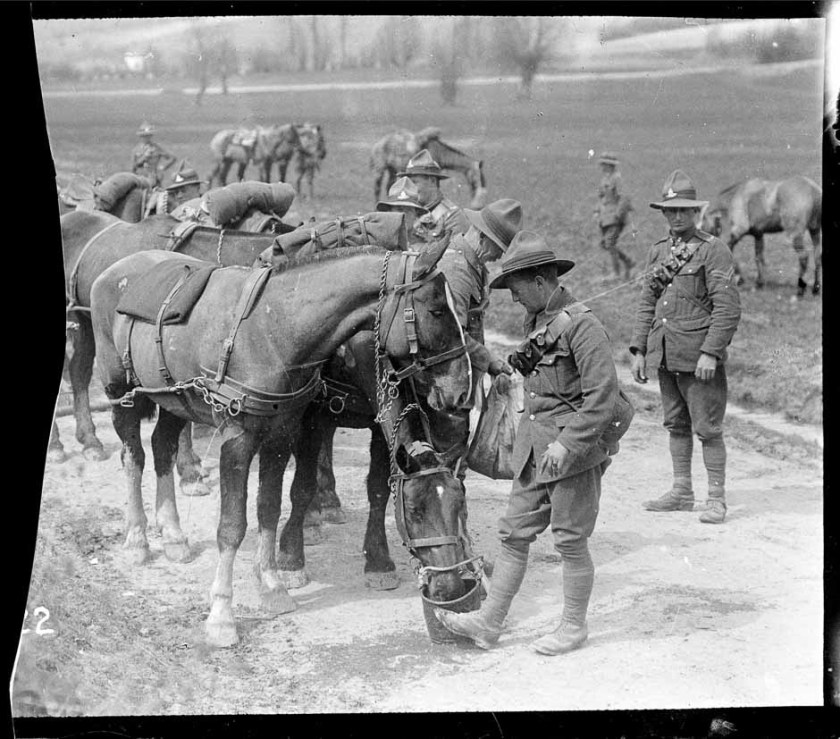
[Image: Feeding the horses of a New Zealand howitzer brigade near Lumbres, France, during World War I. The horses remain harnessed. The horse in the foreground eats from a feedbag. Photograph taken 15 May 1917 by Henry Armytage Sanders. Ref: Turnbull Library, Wellington 1/4-009455-G.]
Sunday, 12th May (1918)
Rangatira has developed a high-pitched tenor note in blowing his hose – a true chieftain, magnificent even in his emunctions, he blows his nose like a bugle.
The mad mare who replaced my deceased hero, will have none of me; her back is one perpetual arch, her eye a maniacal glare, her slender but badly scarred legs move in fitful prancing. I sweat, I swear, making ineffectual dabs with my brush, I seize her legs and hold them up by main force, she lurches at a dangerous angle and threatens to fall on top of her tormentor; or actually lifts the other leg and drops on her knees. The chieftain regards me coldly in stern aloofness, unresponsive to my encouraging pats, his hard little underlip set firm. I groom at his sturdy hocks, which he permits for a while, motionless, indifferent; smack! with lightening rapidity he has lifted his foot and stamped in the vicinity of my boot. But I like him, though my passion is, and always will be, unrequited.
Blue propaganda balloons have been released at intervals and gone sailing over our heads to drop their mental bombs on Fritz’s lines.
7th to 11th May (1918)
Have been amusing the establishment with drawings of my companions. Jock is writing a letter on his to send his wife. The plebeian considers I have given him too wild a glare in the eye. In mortal combat with Demon Mud, in plastic form on the ground, and in concrete stalactites on the mules. The weather is getting like the moist head of Auckland. Not that I’ve got any quarrel with Auckland.
Broad marks across the fields show where tanks have passed, pressing the young crops down into the soft earth.
Good tobacco being temporarily unobtainable I’m making shift with a vile concoction of issue stuff and a sort of black-twist costing the huge sum of 2½d a stick. Though so unlike our bush in matters of detail and lack of undergrowth, the tout ensemble of these old-world woods is reminiscent of our own. Patchy grass in place of our undergrowth showing up the boles of the trees and giving a spacious air. The sound, too, of a chorus of birds of the one hemisphere is very like that of the other.
I was deceived in Duron Lagniez. I thought him a land salesman. After “long argument about it and about it” I must admit that it is the iron gates, on which his legend appears, of which he is, or was, the “constructeur”. I now picture him as a master smith with a square black beard and authoritative bearing, his very gait recrudescence of business. We hear that the redoubtable Von Mackensen is after our gore, but are more put out to hear that the Colonel is going to spring a surprise visit on us soon.

[Image: Sketch by Lincoln Lee, titled “(Driver Jones) Our ‘Bivvy’ of Bus 1918”]
6th May (1918)
For the first time heard a Cuckoo. The note is soft and mysterious, well represented (without the mystery) by the cuckoo clock. I may remark that the Argentine Songster, of whom I gushed one fine morning, looks to be a species of linnet and his note is only a cheerful whistle, but in that period before dawn when “The casement slowly grows a glimmering square”, (N.B. No casement in our bivvy) it seemed a subtler thing.
To show you the extraordinary chances of war – you will remember how a solitary shell casualtied between 20 and 30 horses; today a shell burst right in front of a wagon team. The underneath part of the wagon itself was much damaged and the pole almost severed; the shell-splinters must have passed between the legs of all six animals, 24 legs, without touching one of them, their drivers, or the men aboard the vehicle.
The woods are clothing themselves in foliage, copper beaches are noticeable, the fruit blossoms are commencing to fall.
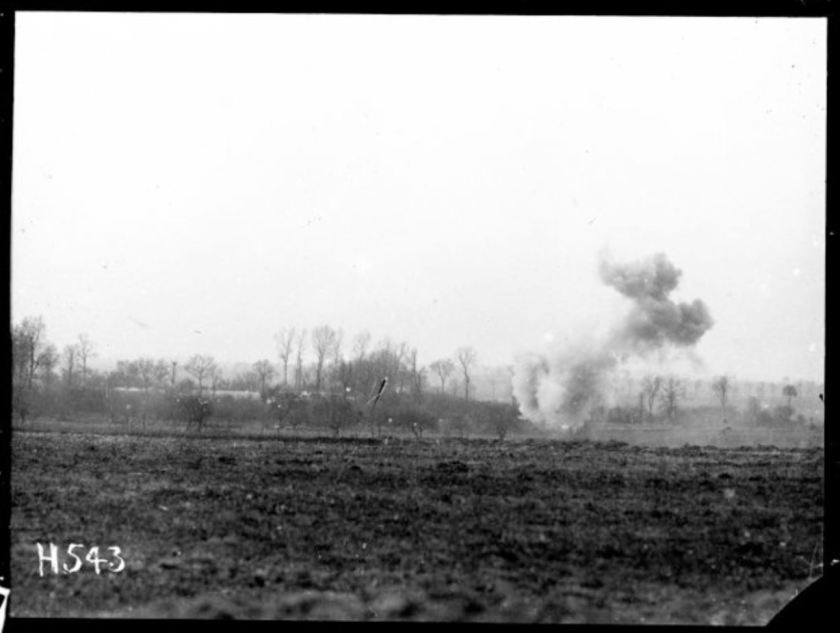
[Image: A 5.9 shell bursts close to the New Zealand reserve line, during World War I, causing a large cloud. Photograph taken near Courcelles, France, 4 May 1918 by Henry Armytage Sanders. Alexander Turnbull Library, Wellington. Ref: 1/4-009515-G]
Sunday 5th May (1918)
We have been treated to a thunderstorm and have received one orange (and eaten it – the orange not the thunderstorm). Today being payday, the Crown and Anchorites are popping up like garrulous mushrooms (have you ever seen one?) bent on securing some of the shekles. “Any more for any more”? “You pick ‘em and I pay – where you like and when you fancy. And the old man has a skinner for dinner. Away we go to war again. And the old man spits blood!”
A bit of humour at the expense of the Tommy artillery bivouacked in an open field behind us. When advising us of our rendezvous in case of shelling, our O.C. remarked “I don’t anticipate any shelling, but our friends over the way seem to have successfully camouflaged their establishment to look exactly like a Camp.”
It was there a man was given “Field punishment No. 1” i.e. spread-eagled on a gun wheel. Our chaps went over and untied him and so “put the breeze up” the Sgt.-Major that the act was not repeated.
A rather nice brand of ‘bully’ is called “Fray Bentos”. The men has seized upon the words as an expression of satisfaction, e.g. “How did you like such and such?” (answer) “Oh Fray Bentos”. The words of General Russell good: “The dawn is already breaking in the East. May you see the Southern Cross next year.” Have only recently known that Rodin is dead; what a loss! This has been my page of oddments. Oh that we two were maying!
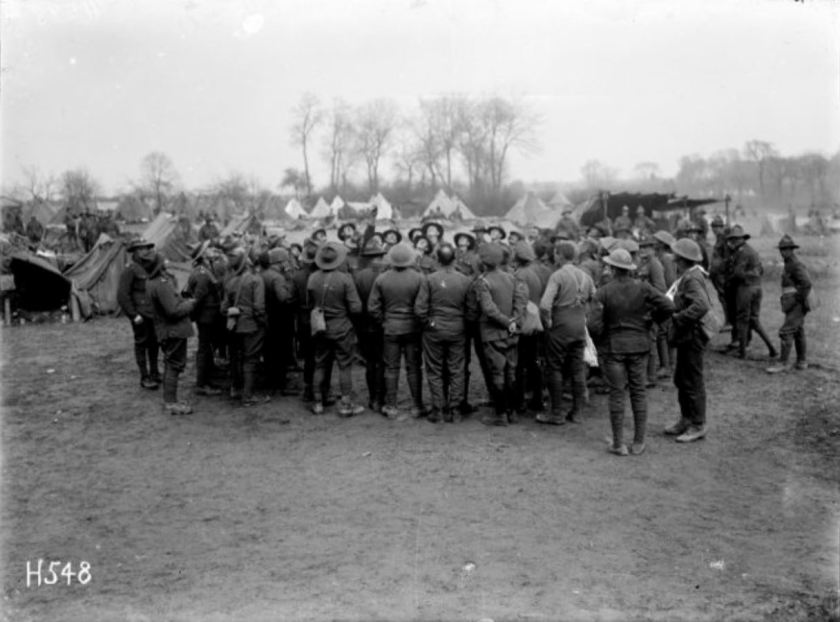
[Image: A circle of World War I New Zealand soldiers watch a game of Two-up at their camp in Louvencourt. Photograph taken 30 April 1918 by Henry Armytage Sanders. Alexander Turnbull Library, Wellington. Ref: 1/2-013163-G]
 Walk March