
To Fleet this evening and fossicked out artists’ colorman. Had another beauty of a red moon to look at coming home, eating chips and fish, hot, out of a piece of newspaper. With Warwick for companion tonight, we made a start through Paradise, but struck a side-track which proved somewhat wild and brambly. Were repaid by stumbling across a hedgehog, curled up in a ball from which he absolutely refused to budge though lifted about by his spikes. The inhabitants tell us there are plenty of squirrels about, but hard to see with the trees in leaf; also snakes of several varieties. Whilst I was sketching, a half grown foal came up, bit my boots, sniffed by hat and sketch and in short, became so familiar that I had to shoo him off. His dam, on the other hand, bolted when she saw me, but she would probably know more about art.
Author: walkmarch
Sunday, 2nd September (1917)
Made Crondall by a track leading over stiles and rustic bridges, through woods and copses from field to field until it eventually landed us near our food-provider’s back garden. We stopped in various shady nooks to eat blackberries and play with a tame pony. This path we afterwards discovered is called Paradise because of its many charms. After dinner we sketched part of the village and a round haystack. That over, we set forth to Odiham, 4 miles further on. A delightful walk along a splendid tarred road with huge elm and oak trees on either side, often meeting over-head. There were some ripping old cottages en route, one of which I sketched amongst its trees and hedges. Near it was an amazing structure, the thatch of which projected far enough to form a verandah and was propped up all round by rustic poles. Odiham: a larger place than Crondall. The first two pubs we came to looked rather pretentious and were styled Hotels. That did not suit us, so we proceeded. Saw some old stocks in which offenders used to be placed (Lights out! and a rough house on owing to the draft men going tonight – Lights turned on again so resume in bed). We wandered on through the long straggly main street until we came to the real thing in pubs – low, old and laced with beams – in front of it the village pump, which we worked and, to our delight, brought water up at the first heave. Sat in the funniest low-ceilinged tap-room at a table made of a single rough oak slab which had been scrubbed out of recognition; served by a rheumaticky old chap from a bar about 4 ft. square – to wit – the cupboard under the stairs. We ate our simple supper there and after I had obtained from mine host a cigar, and not a bad one either, proceeded to our homeward way. The full moon came up a golden globe behind the trees and everything was, to use R’s adjective, “Apple”. The departing heroes of last night made such a mess that I got the job this morning of cleaning up so will also clean up my correspondence.
[Sketch, G L Lee, Crondall. Likely 2 September 1917].
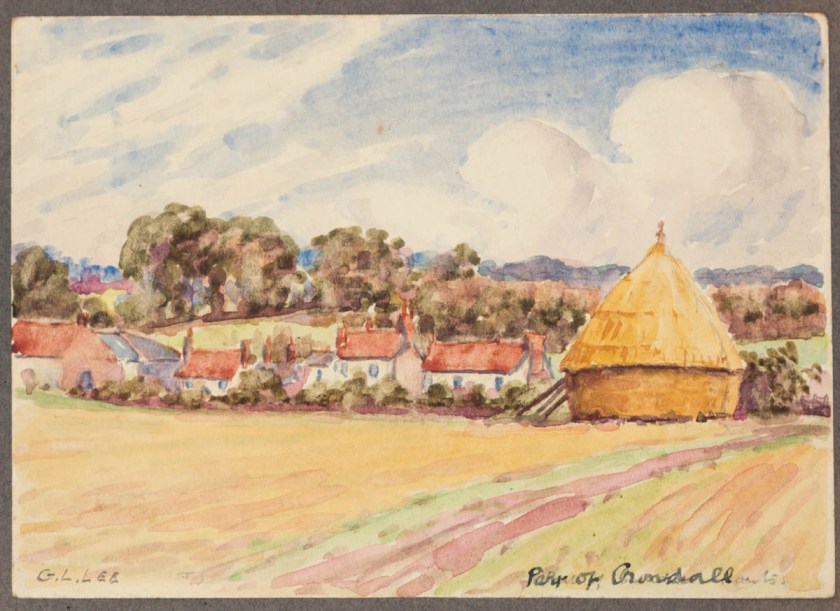
Saturday, 1st September (1917)
An interesting gathering in the old pub last night. The landlady, a pleasant enough woman, chatting with her guests: an intelligent man of about 35 buying some bottled beer and having a yarn with us; a middle-aged chap dressed like a city clerk or business man; a jolly old chap with a bushy beard who cracked a few jokes; two typical old hay-seeds who omitted little sound other than an occasional dry cackle and who were decorated with what R. calls chin-weed, and who both smoked tiny clay pipes; and lastly, we two antipodean artillerymen. It seemed to give the beer a good taste.
6. p.m. “Runnymede” – the name of the cottage in Crondall where we feed. The good wife is just frying the eggs. Ate innumerable ripe blackberries and did a sketch showing Farnham in distance – hay stooks in foreground. The Crondall Church is of Norman architecture built about 1150, the tower being added some 5 or 6 centuries afterwards. The pub is about 200 years old. This village was once the most important centre hereabouts, more so than Fleet or Aldershot, that is why it has more historical interest. This information from the village grocer, from whom R. purchased some very nice cakes called Parkins, crumbly things browned on both sides flavoured with coconut, and full of raisins. Kapai!
Wet weather is menacing the crops throughout the district. In many fields the stooks appear to be going rotten and where grain is still uncut it is getting sodden and broken down. There are many large fields of clover which look pretty and smell better. Tore a hole in my unmentionables climbing a fence – so to the end of another day.
Friday, 31st August (1917)
I saw my largest toadstool (as well as my largest toad) yesterday in Ewshot churchyard – almost big enough and strong enough for a child to sit on. Another loafing morning – ate a lot of blackberries and sawed through a small log – making a gun emplacement. To Crondall in a sunset which made all the little farms, fields and trees glow with an indescribably peaceful beauty. Back through some strange lanes in the moonlight, the effect of which was even more beautiful than the sunset.
Thursday (30 August 1917)
Fleet – a long straggling row of shops in which there appears to be nothing of interest and soldiers everywhere. Spent afternoon pretending to lift logs into waggon and push waggon up a hill. R. and I did our caterpillar act under the rainproof cape for a few hundred yards up to the Queen’s Arms. The small plumes are sloes from which Sloe Gin is made – they taste very bitter.
Wednesday (29 August 1917)
Have been scratching up weeds with an antediluvian implement supposed to be a hoe, and catalogued as such in the camp inventory. Easy job, let off early. Same thing on this afternoon. Being a gunner has its compensations. Take this fatigue for instance, we chop round with our hoes and things, but the N.C.O. in charge has to stand about mooning. We are still in Merrie England – our Officers went straight to the front, N.C.O.s have to revert to Gunner when they get to France. We can’t get any lower.
10. p.m. Started off by stopping a fearful blast from the orderly officer for not standing to attention whilst Retreat was sounding. Walked to Fleet. Walked back by half-moonlight and finished off by nearly being late – in fact just escaped C.B. twice over.
Monday (27 August 1917)
Have just picked tit-bits out of a greenish sea of dried beans, spuds and beef. Item: never disliked margarine. You know my partiality to lardy butter, well good margarine is something of the same but much more crumbly, that’s its defect; you are conveying a portion to your plate and it drops off in transitu (a legal expression).
At Crondall on Saturday we saw a huge hollow elm tree centuries old – its bumps were used as a style to get over the fence from the road. The outer crust was still alive and bore many luxuriant branches.
Had a decent cigar given me and am now lying on my cot puffing it. The blankets here are of diverse texture and colours – violent electric blues, glaring scarlets, lemon-yellows, brown grey and black. Imagine their motley appearance along the sides of the hut. The rain it (to all appearances) raineth every day-a-hay.
Sunday 26th August (1917)
A moist but not unamusing afternoon. R. and I set out for Farnham, a town of about 20,000 inhabitants some 4 ½ miles away. As it didn’t look like clearing up we hit upon an amazing device. I crept under R’s cycling-cape which just held us both and by keeping very carefully in step we proceeded down-hill, like a two-headed 4-legged monster, to the mixed mirth and astonishment of the villagers. The smoke from my pipe gradually asphyxiated R. It continued to rain very hard so we crept along under the trees, accompanied by 3 or 4 very wet youngsters who had attached themselves to us. Eventually we found a tool-shed in which we and the boys crouched for about an hour. By short rushes from tree to tree arrived at length at the castle, which was closed to the public, but as they had left the huge gate unbarred we simply pushed it open and got in, walked around the Castle and climbed up into the keep. Ages old and surrounded by the most beautiful ornamental trees. The seat of the Bishop of Winchester. We then reached the town, an old and interesting one. Plenty of beam-laced houses with projecting upper stories, alms-houses, etc. We found an interesting eating house and had a good feed – the proprietor was a whiskered old wag – quite facetious. From him I cadged a sack which I threw over my shoulders and strutted off through the streaming streets past the spellbound inhabitants.
The chaps in the hut have just been talking about Burns’ poetry, but have concluded by unanimously agreeing that “Ella Wheeler Wilcox beats the lot” (which sounds like a line of her own verse.)
Saturday night (25 August 1917)
With Warwick and a “returned” Corporal to Crondall – joined by R. and a friend of his. They purchased 2 lb. of bacon and a lot of eggs; these we bore off to our one – (here the electric light went out and I came to a sudden stop – Sunday morning) – legged tea-man whose missus cooked it for us. We made back to camp through lanes and avenues, fortified by various drinks. The Corporal told me he was with an artist in Cornwell who got so wild because the Corporal looked at his painting before it was finished that he tore it up and went off in a huff, whereat the Corporal retaliated by remarking that it was silly to make such a fuss over such a rotten picture. Have just been to Church Parade where Padre gave a sensible but of course totally useless sermon on swearing. He said that however meaningless and lightly used the words are they must in time filter through and poison the mind. He didn’t go into side-issue that occurs to me, i.e. will having to listen to it, for perhaps years, have a like effect?
Friday (24 August 1917)
The shortage of sugar has had an extraordinary effect on sweetmeats in England – they are not mostly made of gelatine and saccharine.
To excuse my loquacity I quote Bacon: “If a man write little he had need have a great memory” and (I can’t resist the next sentence though it isn’t in point), “If a man read little he had need have great cunning so that he may seem to know that which he doth not.”
Some of the tallest men were picked today to form a bodyguard for the King at some review tomorrow. We were “standing at ease” and by keeping my feet wide apart and leaning forward I managed to miss it: (Dad will be disowning me).
 Walk March