
London terrifies me. I’m frightened to go more than a few yards for fear of losing myself. Just discovered that the British Museum is only a few steps away, but have no intention of trying to visit it. I should get lost, and spend two or three hours getting back here, revolving round London underground, and doubling on my tracks like a hare.
Author: walkmarch
Monday, 24th (February 1919)
Just left Bailleul, passing Armentiers before dawn, and we are back in the grim old battle areas.
Have said goodbye to Germany and Belgium, and will soon be making my bow to La Belle France. It but remains to kiss the hand of old England and then – no boat can leave too soon for that most distant of her Dominions which, with all its rawness, for me spells “HOME”. Like Ulysses, “I have grown old in travel”, at least older, and have no more years to waste a-wandering.
1 a.m. (Soldier’s Club, Russell Square)
Our passes have been extended a week, so we get 21 days instead of 14.
Sunday, 23rd (February 1919)
We are in the neighbourhood of Charleroi. Hideous mining districts stretch away in all directions, all dotted with the minor Ngaruahoes I spoke of before. Our progress is mostly stoppages.
Tea is made in the last wagon of the train of about 30 carriages, and amusing incidents occur when the train unexpectedly starts off, and there is a scramble of yelling tea-spilling Tommies back to their carriages; which, breathlessly attained, the train promptly stops for another half hour. Evidence of the late war in the form of blown up bridges and wrecked stations and rolling stock are accumulating.
8.30 p.m. At Tournai. The train occasionally moves slowly and painfully for as much as 5 miles, then stops for anything up to 2½ hours. It ought to be oiled.
Saturday, Dom Station: Coln (22 February 1919)
Been on the go since 8.30 a.m., and have at last (4 p.m.) returned to starting point. The army is still working like machinery. Eventually we marched forth under our packs, each grasping a loaf of bread, and a packet of biscuits dealt out by those tireless Trojans, the Y.M.C.A. Good-bye Cologne!
Before morning we should be out of methodical and orderly Germany. She will, I am afraid, recover more quickly than any other country seriously involved, because her people will work.
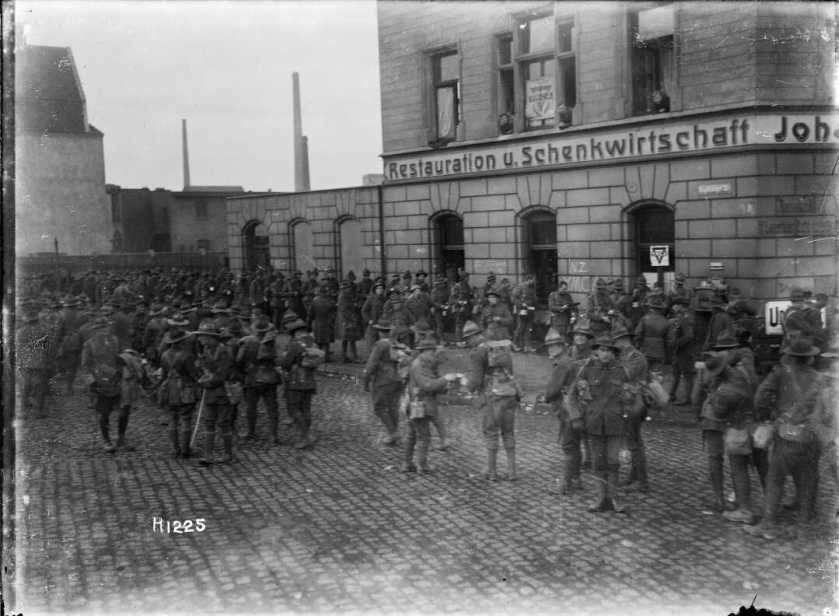
[Image: A large group of New Zealand soldiers shown mingling on the cobblestones outside the NZ YMCA in Ehrenfeld, a suburb of Cologne in Germany. YMCA notices appear on the window of a building with the German words ‘Restauration u. Schenkwirtschaft’ on it. ‘NZ YMCA’ is also written on the wall. Photograph taken after the end of World War I, probably December 1918 by Henry Armytage Sanders.
21st February (1919)
Even grousers have luck sometimes. I go on leave tomorrow morning.
At stables I groomed by last ‘donk’, and he tried to kick. Othello proved a grand if somewhat harrowing work. Most glad am I to have heard Aida and Othello; Verdi in these seems to have excelled himself. The opening of the Opera was most dramatic – no overture – a tremendous crash of drums and cymbals and the curtain rises.
I have packed up my belongings, and, I hope, most of my troubles “in my old kit-bag” and, though it rains now in torrents, feel that the morrow will produce some of the smiles mentioned in the famous song under quotation.
I have taken out my ticket to Penzance, so when next you hear from me I may be “apprenticed to a pirate”.
Like all experience, this will be interesting in the retrospect, though it has of late become very tedious, with the one alleviation of music. What a great amount other countries can learn from Germany in the State support and management of theatres. Here is a community that can see the works of the great masters at prices which in our country would hardly admit one to the “movies”.
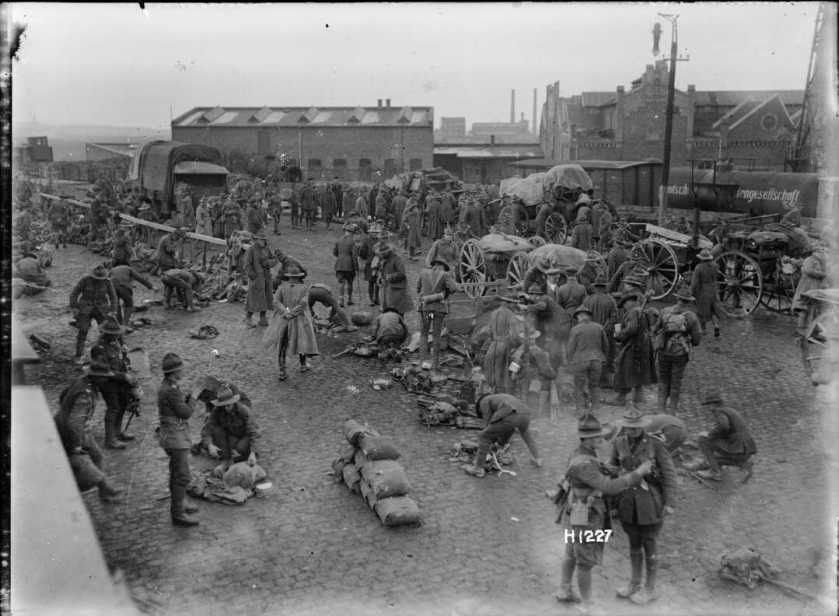
[Image: New Zealand troops and transport assembled at Ehrenfeld Station on the outskirts of Cologne in Germany. Several soldiers appear to be packing their kits. Loaded wagons and a truck appear in the background. Photograph taken after the end of World War I, probably December 1918 by Henry Armytage Sanders. Alexander Turnbull Library, Wellington. Ref: 1/2-013774-G]
Thursday (20th February 1919)
Obtained Opera tickets from a small-boy-profiteer.
The hall in which the concert was performed tonight is a very fine one, handsomely decorated and artistically designed.
The audience evinced great enthusiasm for the songs, locally composed and accompanied by the composer, a black haired giant who, on being recalled for the manyeth time, solemnly blew his nose before retiring.
19th February (1919)
Billets rotten.
We are right under a large Church, the bells of which clash out volubly each morning, about half an hour prior to reveille. The remarks of the awakened sleepers are hardly devotional. Still earlier, the cook chops wood on the hard cobbles, which almost rivals the bells in their responsive tintinnabulations.
Amazing to find myself, the erstwhile new chum, almost the oldest soldier of the remnant of my battery.
Any dicta of mine anent Germany and the Germans have been haphazard and ill-digested, and I am continuously changing my views.
Tuesday 18th February (1919)
The battery has now dwindled to a mere handful – four batteries are amalgamated into one.
Moved quartered again – packed like sardines in a huge bare school-room, with one gigantic heating stove – no tables – no chairs.
Went again to the concert, and enjoyed it. King Lear Overture (Berlioz) – Piano, Poem (Chopin), Symphony (Tschaikowski).
Sunday (16th February 1919)
I am now wearing a pair of boots at least two sizes too big, with inches of “no man’s land” between my big toes and their extremities; rather difficult to steer.
An issue of rum has filled the barracks with song and dance.
14th February (1919)
Got rid of more of our vehicles and harness today – nearer the end, I hope. Attended usual bi-weekly lecture – went to the Opera to find that the programme had been changed and instead of Hauffman, I re-heard what I must take to be Verdi’s masterpiece – the remarkable Aida.
Finished Adam Bede with many regrets at parting with him and his belongings – like the work of most great writers, the book grows upon you as you progress with it.
 Walk March