4th September (1918)

Snatching a moment whilst guarding animals grazing in large avenue of what were once beautiful trees, now blasted by shot and shell.  Every now and again branches break away with a crash.  Was preparing last evening to get a little rest, when we were turned out and pushed off in the dark to the guns, keeping each in close touch with the wagon ahead to avoid going astray.  In this way we proceeded a couple of miles and completed our task.  Fiendish stenches assailed our nostrils out of the darkness.  Groups of searchlights prodded their beams purposefully into the lowering sky, following the laboured vibrations of the enemy’s bombing planes, which dropped here and there hovering parachute-flares to light up their objectives, and the guns spoke and flamed.

Luckily got the first shift on picquet but had all sorts of mishaps in the darkness with horses and teams coming in and not knowing where to go.  Also couldn’t find the men to relieve us, so did about two shifts instead of one.  A terrible spectacle by our “stables” – a broken cellar, used as a machine-gun post, full of dead Germans in dreadful attitudes; killed by Mills Bombs as they rushed out.  How fellows can even go through their pockets and pull the rings off their fingers I don’t know.  But they do.

Terrific bombardment by all our artillery.  After tea my cold seemed to suddenly get much worse and I sneezed terrifically, but soon noticed everybody else doing the same.  We were in the tail end of an attack by “sneezing” or “mustard” gas.  Witnessed a remarkable incident this afternoon – a daring attack on two of our balloons.  Almost before he was observed he had brought one down in flames and was going for another.  The balloonists were soon out of both, gracefully sailing about in parachutes.  He missed the second and made off, amid a hail of shells and bullets.

nlnzimage 1-2 013569-G Group of NZ journalists inspect German bunker, 4 Sep 1918

[Image: A group of New Zealand journalists at the entrance of a large German dugout and the scene of recent engagement with New Zealand troops in World War I. The official NZ War Correspondent, Malcolm Ross, stands in the background with William John Geddis, Frederick Pirani, Charles Earle, Robert Mundie Hacket, and Martin Luther Reading standing in front. Photograph taken in Haplincourt 4 September 1918 by Henry Armytage Sanders.  Alexander Turnbull Library, Wellington. Ref: 1/2-013569-G]
3rd September (1918)

At midnight was hauled out of bed to take up gas shells.  We eventually reached what we thought to be the dump described to us.  Yelled and howled around for half an hour but not a soul appeared.  Our N.C.O. then rode back to report and after an interminable time reappeared with instructions to load up with H.E.  Got to the guns a little after dawn and just as the barrage was being put up for an attack, the whole half-lit countryside flickering rhythmically to the flashes of hundreds of eighteen-pounders.  Clattered back over the cobble stones of the battered town, reaching camp at about reveille.

About 1.p.m.  Boot and Saddle blew and we hooked in, being told the guns were advancing.  As a precaution I carried my haversack and essentials.  Just as well, as it is now doubtful when we will get the rest of our gear.  The trees by the roadside are riddled with shrapnel and the little shell-holes made by the instantaneous fuses are everywhere.  Dead of both sides are littered about.  Early in our march we witnessed the disastrous effect of a random shell, which had a few moments prior to our arrival hit a team and killed all 6 horses and 2 of the drivers and wounding the third.

Now halted under a tattered avenue in the grounds of a chateau.  Everything is going forward – balloons, big guns, and vehicles of every description.

Our reinforcements are having a lively introduction to warfare – “open slather” as we call it now.  Huge fire burnt in the enemy’s territory all last night and the smoke was visible by day – so he is destroying as he retreats.  I have just seen an aeroplane falling in short spirals like a wounded bird.

2nd September (1918)

Night’s rest spoilt.  First Fritz came over bombing.  Just got to sleep again when he started to shell us; they came so near that, led by the Irishman, we hopped out and down into a deep dug-out close by.  Of course the shelling then stopped.

First thing this morning took the road through the dead town.  Saw some monster British Howitzers firing; also a number of wounded, waiting on stretchers, and groups of Hun prisoners coming in, some under escort, some not.  Among them some fearful specimens – a half-witted dwarf, and creatures with glasses of extraordinary thickness obscuring purblind eyes.

Have smashed the nail of my index finger by bumping it with a shell.

Can’t make the Hunter out – though as hungry as a —- hunter, he won’t settle down to eat grass, but lunges uneasily about, snatching here a few weeds, there a few leaves from a tree, stopping to gaze drearily at distant objects and stretch his scarred and nubbly hind legs high in the air.  I am convinced that he is very old and suffers from a complexity of complaints, including toothache and rheumatism.  The Poet on the other hand guzzles indiscriminately, licking up the landscape with his long, lyrical lips.  They both turned giraffe this afternoon and browsed from quite high trees.

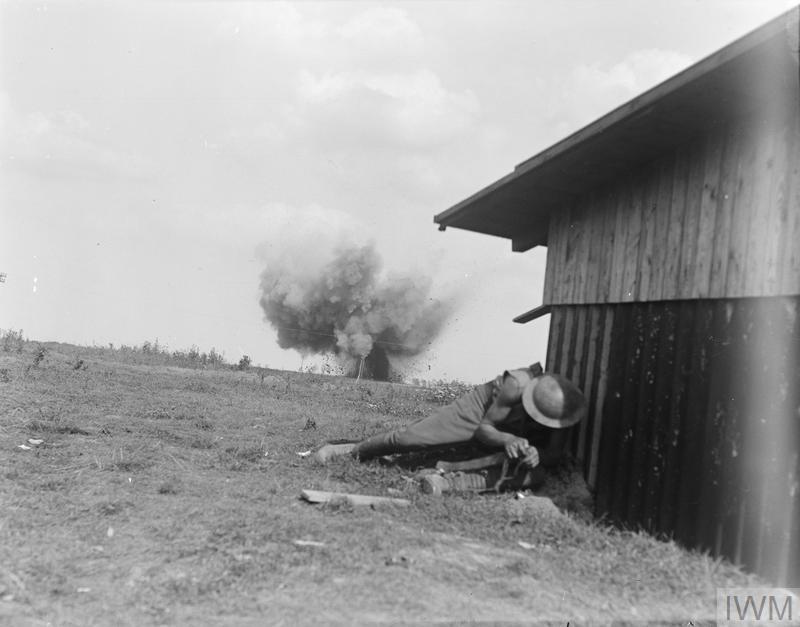
IWM (Q 11255) Soldier NZ Division takes cover as shell bursts, Grevillers, 25 Aug 1918

[Image: A soldier of the New Zealand Division takes cover behind a small farm building as a German shell-bursts nearby, Grevillers, 25 August 1918. IWM (Q 11255)]

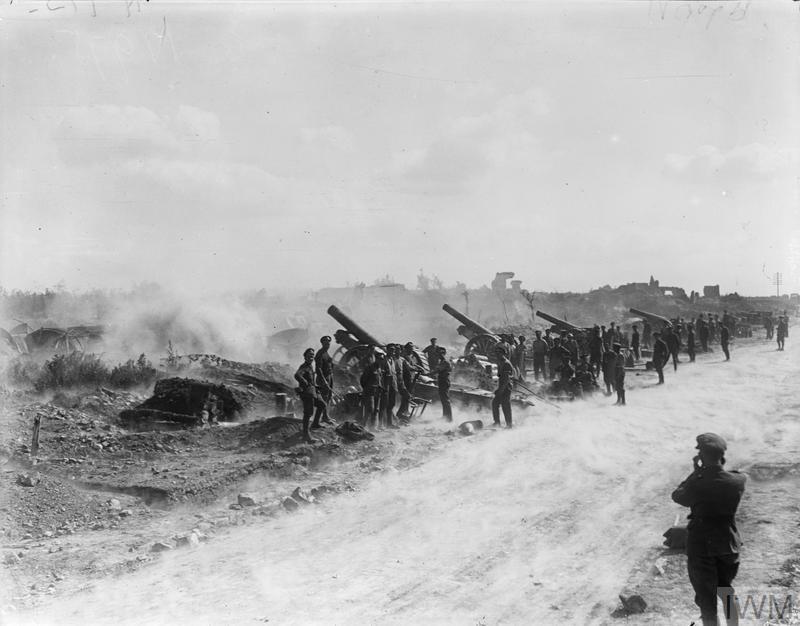
IWM (Q 11502) 8-inch howitzers in action, St. Leger, 29 Aug 1918

[Image: Second Battle of the Somme. Battery of 8-inch howitzers (Royal Garrison Artillery) in action on the roadside at St. Leger. Note dust rising from road as result of concussion of discharge, 29 August 1918.  IWM (Q 11502)]

1st September (1918)

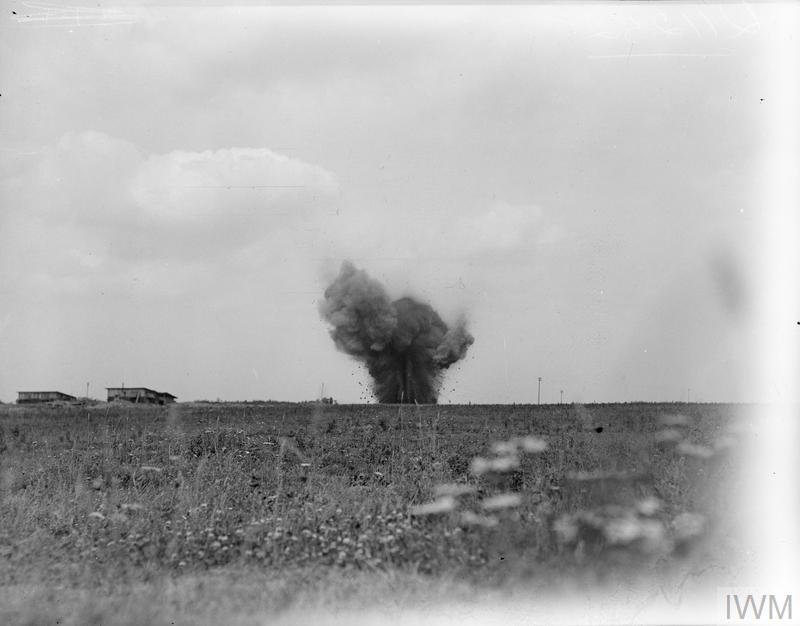
Saw Enormous explosion in far distance, apparently in enemy terrain, either a big dump or a mine – it went on piling and building itself into the sky for quite a minute, eventually assuming the appearance of a volcanic eruption, attaining a height of, I should say, 2000 ft.  Our infantry have pushed on again and this afternoon we moved our guns forward.

My Irish mate O’Shaughnessy, has a peculiar dread of gas and takes all sorts of precautions against it – says he has “no love for the Grave!”  He sees danger in all directions without being cowardly.

6.30.p.m.  A hard afternoon, but an exhilarating and exciting one.  I will try to give you an idea of how field artillery is moved forward in an advance.  The six gun-limbers (2-wheeled vehicles to which the guns are hooked) go up first to the battery; the twelve wagons being kept well in the rear meanwhile, at stated intervals.  At a suitable moment the gun limbers pull the guns out of their pits or emplacements and take them forward to the new positions selected, leave them there and make themselves scarce without more ado.  The few rounds carried by the limbers would have been first thrown out, keeping at intervals of (say) 200 yards and taking a route as much as possible protected from aerial observation.  These all unload their shells at their respective guns and lose no time in getting out of it, as their presence there threatens to betray the battery’s position.  Back to the wagon lines with empty wagons, to replenish them with ammunition brought up by the D.A.C. from the main dumps in rear, which in their turn have been fed by motor lorries or railways.  That is a rough sketch of the operation, but it is the jolting, the banging, the capsizing, and dropping off of loads, the heaving in and out of the heavy shells, the performances of the animals and the moments of peril, that make the business the exciting helter-skelter it is.  We returned by a route right through Bapaume, famous in its hour of destruction if never before.  Not a building intact.  The church in this village (Grevillers) bears date 1564 – it has been left to modern civilisation to smash it to bits.

Got a new tin hat from salvage dump, having driven over my own today and dented it sadly.  Wheel driver also dropped his and flattened it right out.  Those donks of mine!  Today they got so hungry that they ate a quantity of stinging nettles thick with dust.  The Poet is a big coward, but the Hunter doesn’t care a rap for anything.

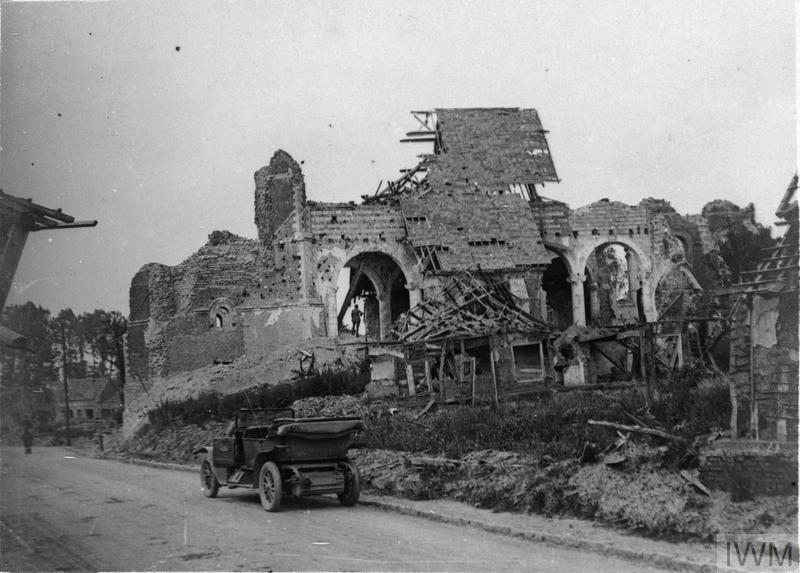
IWM (Q 78484) Ruins of the church at Grevillers, 3 July 1917

[Image: Ruins of the church at Grevillers, 3 July 1917. IWM (Q 78484)]

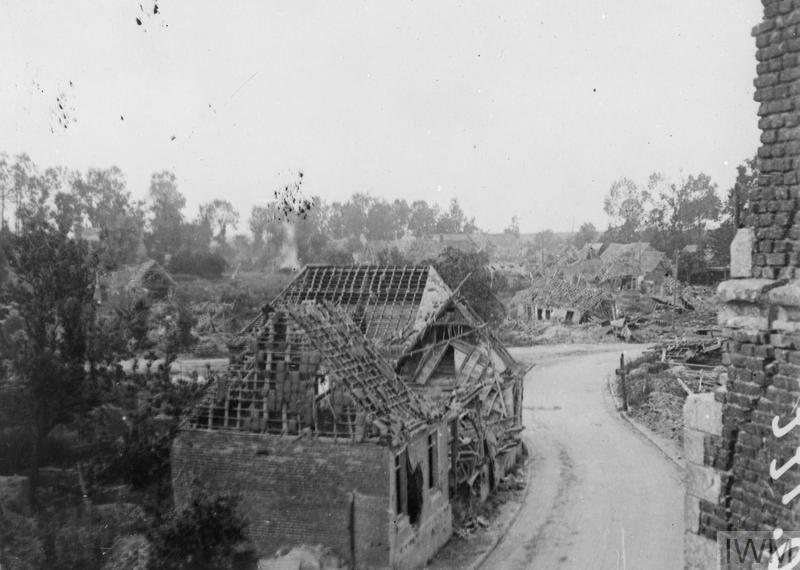
IWM (Q 61212) Ruined street looking from church, Grevillers, 3 July 1917

[Image: A ruined street looking down from the church at Grevillers, 3 July 1917. IWM (Q 61212)]

31st August (1918)

The countryside is alive with troops.  We are right under one balloon and its crew are billeted close at hand.  The big captured guns were dragged out by “caterpillars” yesterday.

Everything is riddled with shell splinters – if you sit down you always find a piece or two within arm’s reach.  A ‘hot shop’ when they are flying!

All around are evidences of the Hun’s intention to winter here – huts, earthworks, and deep tunnels, or ‘funk holes’ slanting down sometimes twenty or thirty feet to underground chambers.  The more canny fellows are occupying the latter; but most prefer the fresh air – anyhow it would be better to be blown up than buried alive.

Visited Y.M.C.A. and heard of exciting adventures of other batteries, some of which have suffered considerably.  One gun was run up until they were laying with open sights, their officer watching the result through his glasses.  Each evening at the Y.M.C.A. a Tommy N.C.O. with intense earnestness stands out between the queues of purchasers filing into the stalls and harangues them in salvationist style.  He has long-service stripes, and two wound-stripes, so has gone through the mill, preaching his gospel in his spare time.

I saw in the distance part of the town (Bapaume) under bombardment against the sky – great geysers of brick-dust spouting upwards as though the whole place were in eruption.  Hereabouts, three days ago, was nothing but a torn and tattered solitude.  Today it is a mass of life and movement – we make our homes in the habitations we have wrecked; amid the ruins of a desolate country.

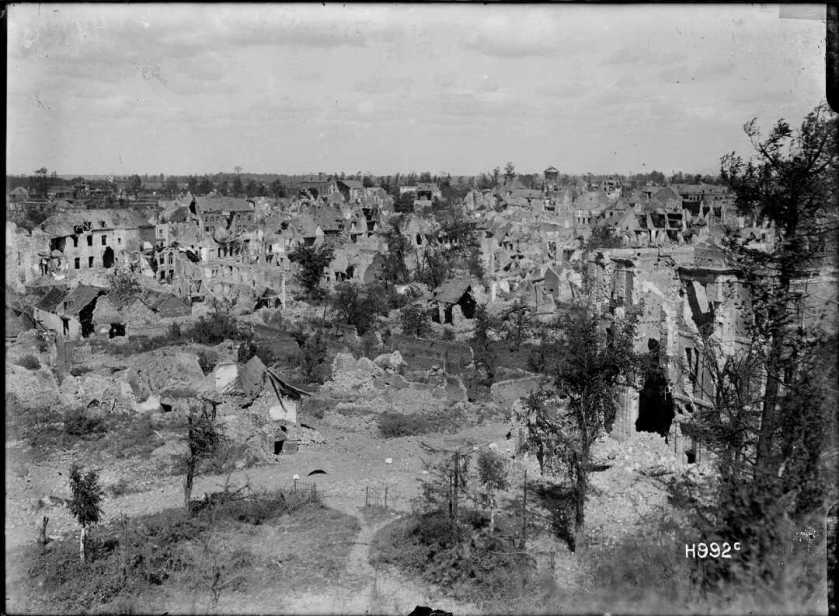
nlnzimage 1-2 013561-G view of Bapaume from Citadel after capture by NZers, 30 Aug 1918

[Image: A general view of Bapaume taken from the Citadel after capture by the New Zealanders in World War I. Shows extensive damage to buildings from bombardment. Photograph taken 30 August 1918 by Henry Armytage Sanders. Alexander Turnbull Library, Wellington. Ref. 1/2-013561-G]

30 August (1918)

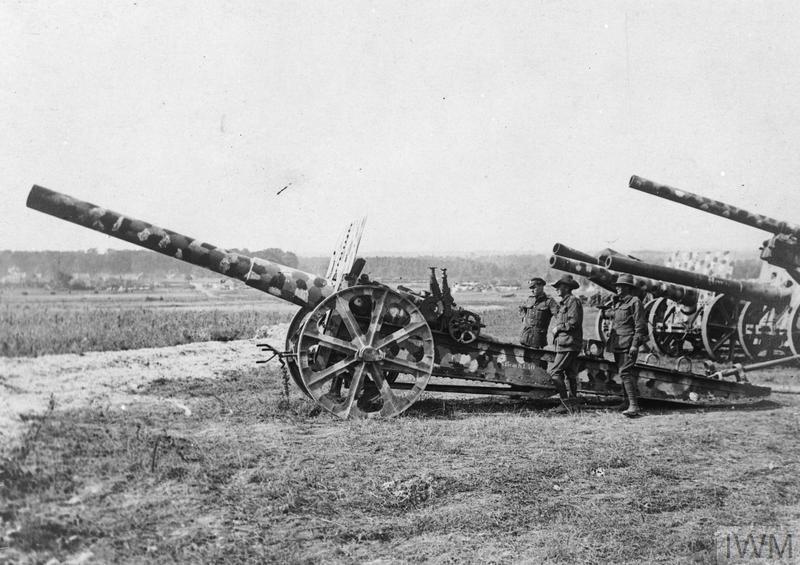
Looking round the Hun’s quarters and inspecting a battery of huge guns, abandoned, together with all their stores, ammunition etc.  They bear the name “Krupp”.  Rather pathetic to find half-written letters among the debris.

Balloons all over the place.  Fritz lobbed a “toute suite” shell somewhere near whilst we were at tea and one fellow remarked that “many more of them would make a fellow swallow a hot spud”.  Had another holocaust this afternoon and burnt all my precious letters.  It is not wise to keep them, an old hand told me that more than once he had had to interfere with men reading and commenting on the letters of men who had been hit.

Oh those terrible mules of mine!  They take long slow strides like camels.  When the shelling started yesterday, I lashed the Hibernian Steeplechaser into a prodigious loping canter wonderful to behold.  The Poet’s groans and grunts seem to say “But this is a fearful business!”

Dozens of our planes going over bombing.

Had a look at German graveyard; their wooden crosses are much grander than ours.  One of the dead was “Englander” so and so, but they had given him the same kind of cross.

IWM (Q 80023) Brit & Aussie troops examining captured guns, Longueau, 29 Aug 1918

[Image: British and Australian troops examining 150 mm artillery guns (captured by the British in the Amiens sector) at Longueau, 29 August 1918. IWM (Q 80023).  Longueau is on the eastern outskirts of Amiens, south-west of where Lincoln was with the NZ Division.  The image is however illustrative of ‘huge guns’ abandoned as the Germans retreated.]

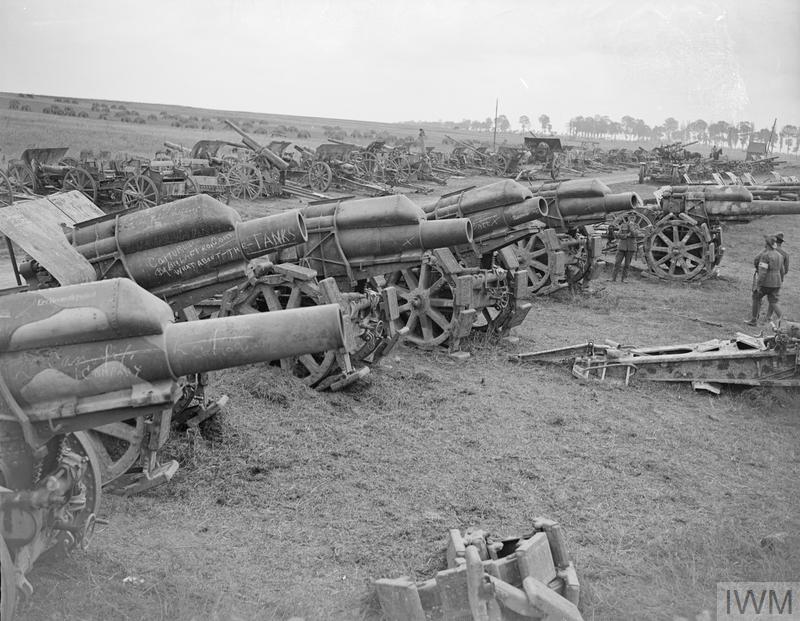
IWM (Q 9269) Dump of captured German guns, Amiens, 27 Aug 1918

[Image: Battle of Amiens. A dump of German artillery guns and howitzers captured by the British Fourth Army, 27 August 1318. One in foreground was captured by the Australian Corps (note a message scribbled on the barrel – “Captured by Anzac Corps. What about the Tanks?”). Those in the foreground are all 21 cm Mörser 16 heavy howitzers. IWM (Q 9269)]

Afternoon (29 August 1918)

At this moment I am sitting in a field far in advance of our recent lines – the Hun having taken it upon himself to retire about 3 miles all of a sudden.  We are halted here awaiting orders where to proceed.  This is open warfare.  A few minutes ago a small army of tanks came rumbling across the fields in the direction of the scene of hostilities.

Today we got within the enemy’s aerial or balloon observation.  He started to open out on the road we were following.  Then came the shells – thick and fast, failing at first a little ahead, then right amongst us.  Several horses were hit, but no men.  We could feel the heat of the bursts.  We lashed our teams up wildly and bounded on over the shell-holes, those teams who had animals killed casting them out of harness and proceeding with the remainder, some of them right to the guns.  The ammunition was then heaved out in a matter of seconds and we continued our mad career back to the new wagon lines.  This sort of thing is more or less inevitable when the enemy withdraws.  You must push on in the open to keep him within range and with what guns he keeps in action he has a good target.  The war news is now good and there is some hope of being “in at the death”.

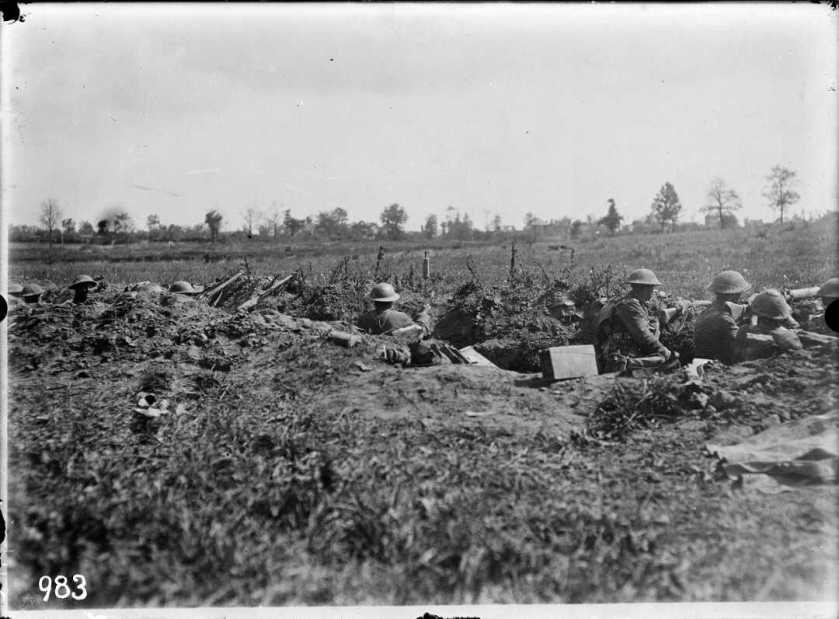
nlnzimage 1-2 013552-G Wellington Regiment waiting to enter Bapaume, 29 August 1918

[Image: A Wellington Regiment waiting in a trench, during the World War I Battle of Bapaume, before entering the town. View from behind the soldiers looking across a field towards Bapaume. Photograph taken 29 August 1918 by Henry Armytage Sanders. Alexander Turnbull Library, Wellington. Ref. 1/2-013552-G]

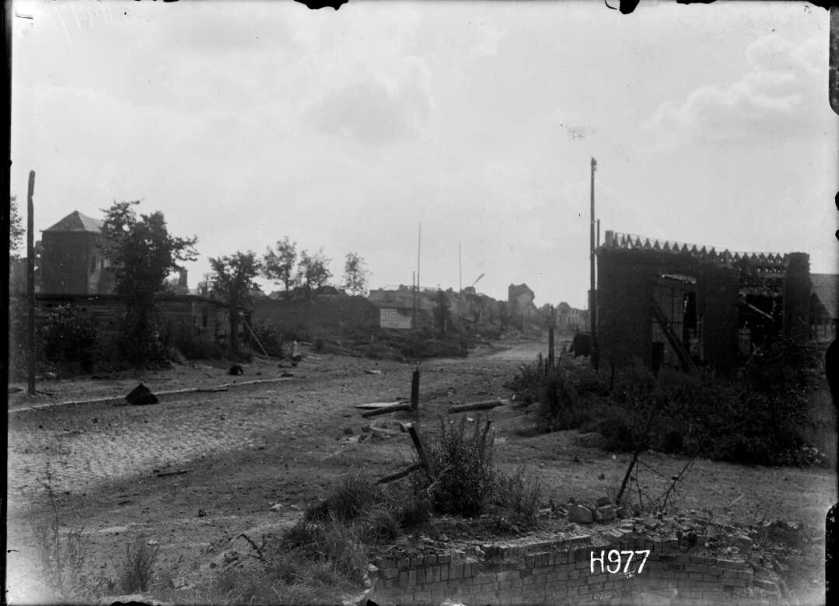
nlnzimage 1-2 013546-G General view of Bapaume after NZ troops capture it, 29 August 1918

[Image: A general view of the French town of Bapaume taken within an hour of New Zealand troops entering it. Shows the huge amount of destruction caused during the heavy fighting there in World War I. Photograph taken 29 August 1918 by Henry Armytage Sanders. Alexander Turnbull Library, Wellington. Ref. 1/2-013546-G]

29th August (1918)

Trip after trip to the guns.  Some “yankee starts” when whole batteries of 6 inch howitzers barked in our faces out of the darkness, especially from the new long-range high-velocity 6 inch guns, which have the most ear-splitting crack of them all – almost like the Crack of Doom.

I am now in the slowest team in the battery, whereas in the days of ‘Rangatira’ and the others it was one of the fastest.  My two ungainly giants have to be whacked along from start to finish.  The Poet emits his camel-like grunts the whole time.  They are strong, but slow and lazy and the rest of the team are in their way no better.  One preposterous donk, ‘Jinny’ with colossal ears, falls down periodically and lets the others walk on her – seems to enjoy it.

At the finish we found the corporal had saved a pint of beer (heavens knows where he got it) for each of us and I can assure you we had no difficulty in washing down some hard biscuit and cheese with it.  I am grazing my steeds near some trenches bearing every sign of a hurried Hun evacuation – helmets, great-coats and gear of every description thrown about in confusion.  Hun equipment figures quite largely in our battery just now.  More than half the men have not been able to get their gear up from our old lines and they now appear in German caps, greatcoats, etc. and eat out of a huge Hun cooker in full swing and last night our stew contained cabbage, macaroni etc. meant for Fritz.  It is also interesting to see notices in German all over the countryside and to inspect the numerous dumps and other abandoned munitions – all very different in appearance and design from our own, though none the less effective.  They encase many of their shells in wickerwork covers.  Everywhere is evidence of their great want of copper – even the driving bands of some of their shells being made of a substitute.  One cannot but admire the ingenuity with which they overcome difficulties.

You people have some mistaken ideas as to our personal attitude towards the enemy.  You suggest that one would feel especially bitter against them on hearing of a brother being wounded.  We have no such feeling, and the only way to realise why that is, is to be here.  The men are hardly philosophers, but few of them are little-minded enough to harbour any personal spite against the soldiers who are forced to fight them and whom they are forced to fight.  We know that the Germans are neither more degenerate nor cowardly than we are – it is their rulers who are to blame, and when you see a dead German you feel just as much pity as you do for a Britisher.

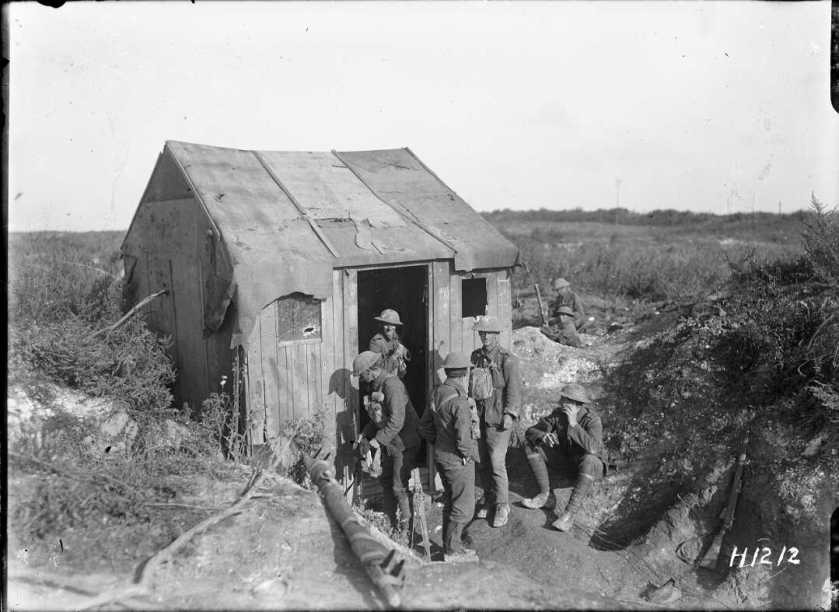
nlnzimage 1-2 013759-G NZ troops with a captured German hut, Bapaume, 27 Aug 1918

[Image: New Zealand troops with a captured German hut, Bapaume, France. Photograph taken 27 August 1918 by Henry Armytage Sanders. Alexander Turnbull Library, Wellington. Ref. 1/2-013759-G.]

26th August (1918)

Were I able to write coherently and give you a full account, one day would supply more of the thrilling and entertaining, than three months of life in the wagon lines.  All day in the saddle, carting ammunition from one place to another, getting an occasional snack and a pull from a water bottle, given our mounts a mouthful of grass here and there at an occasional halt and watering them with a moistened mixture of mud, frogs and beetles, from shell holes and empty village ponds.  The most vivid effects in the evening and night.  Imagine traffic, such as London streets never witnessed, carried out in darkness and almost impenetrable dust without a single light – Endless streams of vehicles of every description; shouted orders, directions and curses; horses plunging over rough ways and dragging their bouncing burdens up hill and down dale.  In one place a grotesque herd of huge tanks came crawling and tottering up an embankment, smashing down the sides of the sunken road in their unwieldy gyrations.  It was like a scene from another and madder world – Hell would seem tame after it.  Old Nick will have to pop up and take a few lessons if he hopes to “put the wind up” the survivors of this war.  All this to the accompaniment of endless gunfire – great belches of flame and thunder right in your face, from a distance of a few yards, and of bursting shells from the other side.  It isn’t too safe here, but the Hun prisoners say “you want to be over there to know what bombing and shelling is”.  The night ended in a dreary wait of hours in torrential rain.  I had my name and unit noted by an irate traffic officer and shall probably be court martialled and shot at dawn.

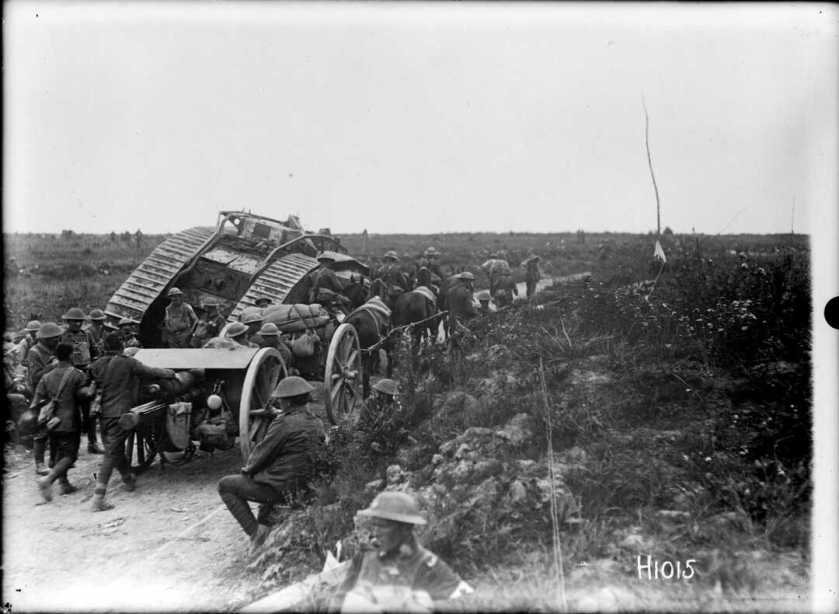
nlnzimage 1-2 013581-G NZ guns being transported forward

[Image: New Zealand guns being transported forward during more open warfare in France during World War I. Shows a horse team pulling a gun carriage past an abandoned tank on the side of the road. Photograph taken Grevillers 26 August 1918 by Henry Armytage Sanders. Alexander Turnbull Library, Wellington. Ref: 1/2-013581-G]