Wednesday (5 December 1917)

Well, we move up to new positions tomorrow.  The frost this morning was intense and the ice on the ponds quite thick.  This cold clear weather has the advantage of rendering the ground dry under foot.  The trumpet has just blown “Come and get your pay” and there is great rejoicing in the camp.

9.30. p.m. Spent the evening with Campbell at a sort of variety entertainment by some chaps out of Yorkshire regiment.  The show was excellent and well put on – had a real good laugh.

Tuesday (4 December 1917)

Had a mounted inspection by a Major this morning and got half-holiday this afternoon.  There was a slight sprinkle of snow, just enough to glitter.  These villages are much more squalid and crushed together as it were, than the pretty English ones and there appear to be no neat little gardens and creepers etc.  So far France has never appealed to me as a place to live in.  There has been a decided improvement in the tucker lately, our canteen profits being partially used for that purpose and we have been getting good porridge and plenty of vegetables in the stew as well as the usual bread, margarine, cheese and jam – “Butter” or jam, both never being issued at once, but one can usually save a bit for the next meal.  Do these details interest you?  W. is snoring loudly.

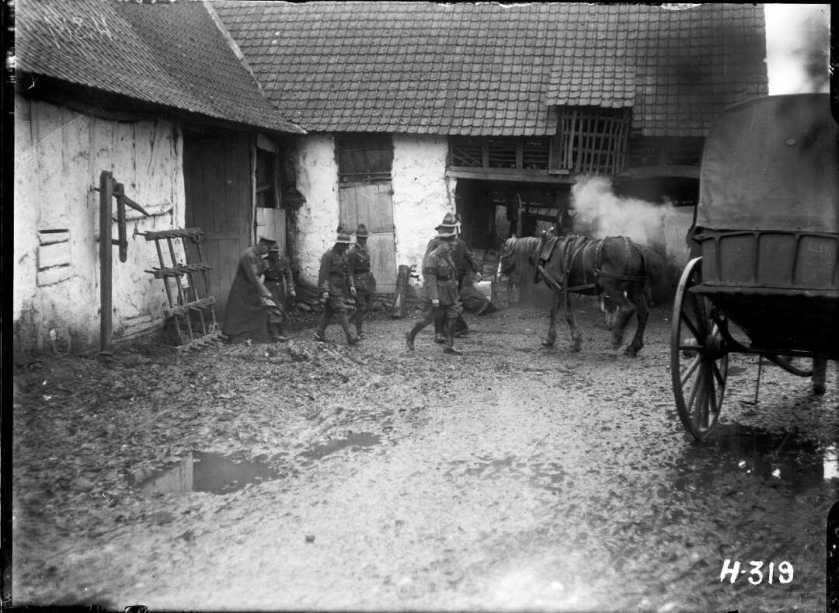
nlnzimage 1-2 012960-G

[Image: Major General Russell, the New Zealand Commander, accompanied by officers, on a tour of inspection of the billets for the 2nd Canterbury Regiment in the small French village of Quesques. Photo taken 25 October 1917 by Henry Armytage Sanders.  National Library, Ref: 1/2-012960-G.]

Monday evening (3 December 1917)

At the early hour of 5.30 the sun set, Venus in the West and Jupiter in the East, backed by the intermittent flashes of the distant “heavies”.  I can’t help feeling that the sky is much nearer here than in N.Z.  The gloomier winter conditions give one the impression of being shut down under a big lid, but there is a sort of soft sweet colouring and tinting of the distance that awake one’s atavistic memory of Northern winters.  In France proper the estaminets are all “To the (so and so)”, as “Au Lion D’or”, “Au Debit des Boissons” etc., here they are “In the etc.” as in “In Den Old Stein Bier Huis”.  There is one about every 100 yards.  To revert to the great topic of “Buckshee parcels” these café au lait and other soluble drinks are, I believe, very nice once made, but dashed hard to get made.

[Note – on 3 December 1917 the 1st Otago and 1st Canterbury battalions of the NZ Division attacked German positions at Polderhoek Chateau in the Ypres salient.  The attack faced determined German resistance and the Chateau was not taken; some ground was secured and later German counter-attacks were repulsed.  NZ forces suffered around 500 casualties, including 130 dead (a bit more than half the 800 effective combatants).  The Germans recovered the taken ground some 9 days later.  Private Henry James Nicholas received a VC for his actions during the fight.  See also Colonel Hugh Stewart, ‘The New Zealand Division 1916-1918’, Whitcombe and Tombs Limited, 1921, pp. 305-314.]

Sunday, 2nd December (1917)

In the dull weather with leaden sky the country is looking sad and gloomy, but it is not un-picturesque, especially the hill-top windmills, which take my fancy greatly.  Of course, the whole country-side here, as it is everywhere within a belt of perhaps 10 to 15 miles wide behind the lines, is riddled with military activity and quite abnormal; still one can study something of the remnant of its inhabitants, their abodes and belongings.  (Have just drawn my rum issue which we get every other night, and am toping it out of a tin.)

Interesting to recognise here and there someone with whom I have at some place and some time been in camp.  There was a white, but not very severe frost this morning and a few flakes of now this evening, the day breaking a little before 7 a.m. and darkness settling in soon after 5 p.m.  All indications are for a mild winter.  We soldiers look a chap wounded and in England as being in luck’s way and don’t dream of being sorry for him.

Item:  I have found that I can dry a damp pair of socks by hanging them above my candle.  About a week back I badly burnt a good pair and for penance sat right down and darned up the several huge holes.  I scorn the numerous needles in my “housewife” and do everything with a curved sack-needle I have.  Once you have pushed its burly blade through the fabric you know that there is plenty of room for the eye and the wool.  Put one in the next parcel.

Strange to see small groups of civilians, mostly women, going off to church in their Sunday blacks; one begins to forget that there is such a thing as civil life.  The stables here are almost dark inside and it is weird pottering about with the mules in them, grooming, watering and feeding the long-eared mongrels.  One of my mules is a quite energetic little fellow; the other is very touchy and troublesome.  By the way, when we were up at the lines one of the chaps killed a mole which had been burrowing in our ‘bivvy’ and I found that my conception of that curious little animal was entirely wrong.  It was only twice the size of a mouse, almost oblong in shape, covered with fine black fur, blind, with embryonic eyes, pig-faced, and had great bare hands turned sideways for scuttling out the earth.

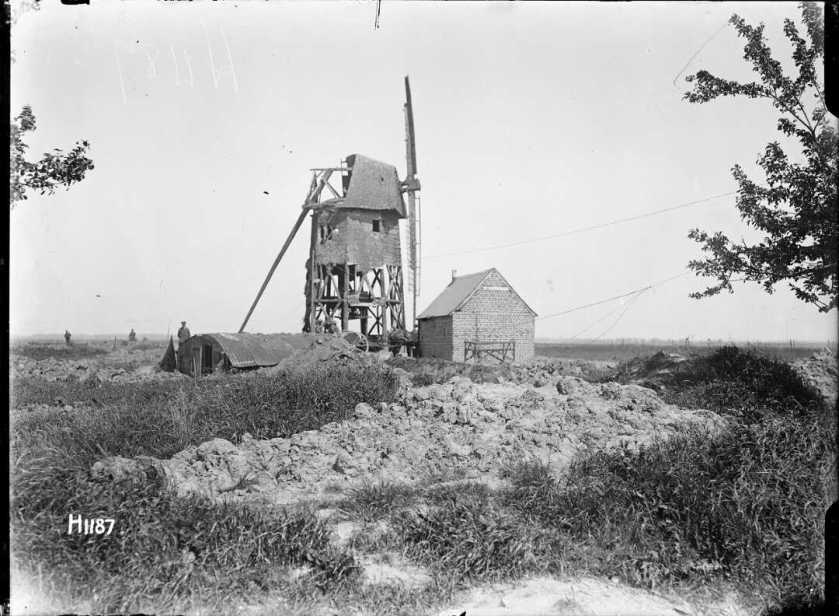
nlnzimage 1-2 013736-G

[Image – A badly damaged windmill that has withstood repeated shelling in World War I France. Photograph taken near Courcelles 31 May 1918 by Henry Armytage Sanders. National Library, Ref: 1/2-013736-G]

29th November (1917)

This morning we set off on horseback for another bath, obtained after a ride of about 5 miles.  Villages and towns peep up all over the place and on the crest of each hill is usually a picturesque old windmill – “Behold! a giant am I.”*  Standing in the bath I found myself face to face with another nude, and a very familiar one, Campbell who was in the same office with me in Auckland.

* First line of ‘The Windmill’ by Henry Wadsworth Longfellow:

Behold! a giant am I!
Aloft here in my tower,
With my granite jaws I devour
The maize, and the wheat, and the rye,
And grind them into flour.

Sunday, 25th (November, 1917)

Here goes for a fresh start in a fresh place (I don’t know its name) 10 or 12 miles away from the last.*  We are still well away from the lines though more within their sound, and we are in low wooden huts.

Mad and amusing experience in a little shop, where Madam went to no end of trouble and gesticulation to explain that the police wouldn’t let her sell coffee to soldiers, but that if we went into the back room and got a cup from her mother (and paid for it), it would probably be alright.  It was.

The chaps in this hut made a furious fire in a brazier early this evening and, as there is no chimney, we were almost blinded and asphyxiated.  They never do anything by halves.  The fellows are wonderfully light-hearted and cheerful which, considering how many of them are Gallipoli veterans, is a remarkable thing; they have simply got used to the whole affair.

* The infantry of the NZ Division had returned to the front at Ypres on the night of 14-15 November 1917, while the divisional artillery remained behind the lines.  On 25 November both the 1st and 3rd Brigades and the Divisional Ammunition Column marched to waggon lines in the Boeschepe area, moving from Wallon-Cappel (near Hazebrouck) via St. Sylvestre-Cappel.  They remained in the Boeschepe area until they received orders to return to the line in the Ypres salient on 5 December.  See J. R. Bryne, New Zealand Artillery in the Field, 1914-18, Auckland (1922), pp.199-200.

Watering Point at Louvencourt - NZ Artillery in the Field p208


[Image from J. R. Bryne, New Zealand Artillery in the Field, 1914-18, Auckland (1922), p.208.  Louvencourt is in France, south-west of Arras and some distance from Ypres.  It is unknown when this photograph was taken; it nevertheless well-illustrates the work required to care for mounts.]

20th November, 1917

My “little Mary” has been a bit out of order, but am getting her right again by drinking plenty of hot milk which I buy from the farmeresses and heat up in my mess-tin.  Practically all the rustic population here is Flemish, the French appearing to prefer town life.  Flemish is a rather ugly language, several words being identical with their English equivalents, e.g. ‘water’, and it naturally contains an intermixture of French but it is a low German language like Dutch, English, etc. (it’s rather annoying to think our language is “low-German” isn’t it?).  Their children are taught French in the schools but probably relapse into the vernacular.

Have recently noticed a number of very large birds in the fields, of a deep bluish colour, which I imagine to be jack-daws, and a few still larger birds which have extra-ordinary long wand-like tails and strut about in great importance – they beat me altogether.  The cattle seem to be kept in stalls practically all the time, the land being used entirely for cropping.  The most hideous, flop-eared flesh-coloured porkers flounder about in the filth of the farm-yards all day long.  Their ears are so huge as to practically blind them and their lives seem to be a succession of shocks at finding themselves running into some danger or other.  It is quite prehistoric to see men sowing by hand, using a flail, harrowing with one horse and a wooden implement, three-wheeled waggons and so on.  We are sprawling about in our barn trying to read and write by the most villainous slush lamps, the grease from which is drip-dripping over our belongings.  The doors are so small that the interior has never seen the light of day and we lose our smaller articles in the straw, then hunt for them with matches, lighted cigarettes or flash lamps.  Have just been interrupted by a rather exciting diversion in the shape of W. and his neighbour (on the outer edge, who says that with 2 lawyers one side and a yawning gulf on the other he is literally between the Devil and the deep sea), getting the slush lamp quite out of control and having to empty the whole blazing mass out into a mess-tin where it slowly and alarmingly spluttered and stunk itself to death.  Alas, more joy is in store for us, a fresh batch of those unnatural beasts with the reciprocating or rag-time ears having just arrived; moreover I hear that they are both fat and frisky, even frolicsome in their freshness.  To regale you with any detailed account of the encroachment of King Mud, or mud in relation to mules, or mud in any shape or form (it hasn’t any) would not prove very entertaining.

15th November (1917)

Today is sunny and we have been riding bare-back exercising our animals, which usually entails a certain amount of fun.  Yesterday a huge hairy and hideous ‘donk’ (the redoubtable Irish Hunter of whom more anon) broke away and in the throes of temporary freedom gave us an exhibition of riderless or spontaneous buck-jumping.  A quaint type of farm waggon is often seen here, 3 wheels only (the small one in front on a turntable) the horse being hooked on to a swingletree and driven with one long thin rein.  He is apparently guided by voice.  Other waggons have one lone rough beam fixed underneath and protruding in front, and in no case are they backable (to invent a word); not very convenient, but very picturesque, with curved sides.  I went and got mine and W’s washing this evening.  The farm folk who do it appear to be Flemish and don’t understand French any better than English, but one of them, a bright and rather handsome girl of about twenty, has learned not only to speak but to read English very passably during the war.  She is a great sport and knows all the boys by name.  It is the custom now for every farm to keep a sort of open house where soldiers congregate in the evenings and are provided with beer or coffee.  Tonight père who is evidently a bootmaker (inter alia) was mending boots, mère was darning soldiers’ socks.  The kiddies were delighted when I learnt a little chanson of theirs and sang it back to them.

“Allons mes amis, Il est midi”.

Got a P.C. from R today; he is at the base camp in France and expects to move up shortly.  J. is with him and they seem to be having a royal time with some French friends they have acquired.

13th November (1917)

In the evening went to the neighbouring town with a Scotch chap named Guthrie who was amusing company.  We had a meal, a few drinks, smoked cigars and back.  Whom should I see lined up for breakfast after stables was over?  An unshaven and not so tidy as usual personage – W.  He had got out of the D.A.C.* in which he had been put on the night we were separated and he arrived last night, actually passing the night in this barn without knowing I was in it, and “here we are again”, comrades in arms.

This evening we wetted our reunion with canteen beer and hunted out a farmer’s wife willing to wash our dirty clothes.  W. had been on similar work to myself but with a much more easy-going crowd – no shave every day – clean buttons etc. as it is with us.  Is it not amazing that there should be no uniformity of hours of work and of discipline throughout the army, but that in each unit it should depend on the whim and caprice of the man in charge and so, like Equity in the middle ages, be as variable as the size of not the “Chancellors” but the O.C.’s foot**.

* “Divisional Ammunition Column”, ** “Officer Commanding”.

10th November 1917

(Near Haazebruk [Hazebrouck]).  We have trekked about another 10 miles and are again in billets (I am in a barn perched up on a stack of dried peas).  We have been here about three days and seem to be going to stay for awhile for a rest, though we are on duty practically the whole time.  Horses are of course, like the poor, always with us and always a nuisance.  The farm buildings are very picturesque and differ from the English ones, being built higher with very sloping roofs, usually thatched neatly over ruddy tiles.  We can’t keep free from “passengers”.  I am already very much a martyr and less inclined to bless the Duke of Argyle than to curse the beasts that necessitate the “scratching posts”; in any case one per mile would be quite useless, you need one every five yards.  The walls of most of the buildings are of mud, which sets very hard, plastered on laths between stout oak beams.  Every small town and village has a large and often handsome church or cathedral and there are shrines of various design all over the countryside.  This part of France is a land of ponds.  There are very few streams and I haven’t seen a river worth the name, but every field has its pond surrounded with stunted pollard trees, and the farm houses and buildings are invariably situated near one or more of these ponds.  At them we perform all our ablutions and as they are muddy and dirty holes you can imagine what it’s like, groping about their slimy margins on these early autumn mornings.  “No bon” as the men say.  The leaves have not yet all fallen and in some parts the long rows of graceful trees are very beautiful.  The country about here is highly cultivated.  The root crops are stacked in large pyramids, the sides of which are packed up with straw kept in place with sods.  Beans and peas seem to be grown as well as the usual cereals.  There are practically no fences, the large fields being cultivated right up to the roadside, where there is usually a bank, or a ditch.  Had great fund poking around the town of Haazebruck in the dark, going into shops, estaminets etc. and buying, pocketing, eating and smoking all the useless and unnecessary things I could think of.  A night out.  Also great fun talking or trying to talk to the various Madames, Messieurs, and Mademoiselles in the shops; one of them, who told me she had been a schoolmistress went into shrieks of laughter over my attempts.

Reveille is at 6 a.m.  Stables at 6.30.  Breakfast about 7.45.  Parade 9.  Lunch about 12.  Parade 2.  Tea 4. or 5.  Picquet about once a week.  The mud is everywhere but one gets used to almost anything and a percentage of mud on one’s person and in one’s food doesn’t seem to do any harm.  All the institutions of an army in barracks are carried on in the field, but under greatly altered conditions – your horses are in lines tied up to ropes and stretched between the wheels of vehicles – instead of huts you have if you are lucky, billets in barns and the like, or if you are nearer the firing line you crawl to sleep under pieces of more or less leaky tarpaulin stretched over a low wall of sandbags, or a few pieces of timber.  It is almost an impossibility to keep one’s feet dry even for a few hours.  Instead of a majestic personage in a well-built and orderly store, the Quartermaster is a mere sergeant in a muddy and muddled tent.  The saddler, bootmaker etc. fare similarly.  The canteen is a hardened individual surrounded by a heterogeneous heap in a fowlhouse, a pig-sty, or a hole in the ground whence he hands you your high-priced merchandise.  And so the game goes on.  On each level sit, squat, sprawl or kneel, men, writing, gambling, exchanging repartee; candles flicker from makeshift brackets and stands (mine is the back of a blacking brush the handle of which is stuck into a crack, others use, against orders, inverted tin lids) and from every available nail, rack, rafter and rope depend their garments and belongings.  They are now arguing about the spelling and pronunciation of the word ‘wagon’ or ‘waggon’ – the wags.

You would like to sleep here.  Everything that you enjoy, cobwebs and their weavers everywhere, bugs, lady-birds, and other varieties of insect life, and a nice cool draught.  Of course there aren’t devastated cities everywhere, but in the (in every sense) blasted town through which I used to ride it was curious to see how the debris had been turned to military use.  On what appears to be the utter ruin of a house you’ll see the symbol of Y.M.C.A and on closer inspection will notice a packing-case door in it and will know that somewhere in the bowels of the rubbish heap is a cup of coffee and a cigarette and will dismount from your jaded ‘donk’ and partake.  Other heaps bear other legends and in what was once a city of civilians, a city of un-civil-‘uns is now ‘carrying on’.  You soon lose all nervousness about the explosives you have to handle and get very aggrieved if some ‘sub’ in charge of an ammunition dump takes it into his head to enforce the order against smoking in the camp.  You capsize a heap of H.E. shells so they clatter with resounding thwacks down upon their touchy fellows and you only swear at the bother of picking them up again.  You are delayed for an hour under fire by a stubborn and dead-beat donk’s refusal to negotiate a shell-hole; you go berserk, tweak its nose, kick him in the jaw (it isn’t a question of cruelty to animals but of serving guns) but you don’t bother at all about the shells that drop in the neighbourhood – that comes later on when you have done your work and have time to think.  One can never realise strange conditions of life without actually experiencing them and so I have found almost everything different in appearance, in dimensions, in detail and in assemble from what I had anticipated.

I must say that rough as the men mostly are I find a lot to admire and envy them for – a cheerfulness under any conditions, great loyalty to our cause beneath all their sarcasm and expletives – hardihood and boldness and a capacity to “stick it”.