13th January (1919)

Germany is working entirely on paper money.  I have not seen a coin above ½ mark value, and as a rule even 10 pfennings are paper money, i.e. ½d.

The Rhine is now several feet lower than when we arrived; confined between walls, its width does not vary.  Powerful tugboats are forever hauling strings of barges up and down.  As an indication of the value some Huns place upon their iron crosses – one was sold to an artillery-man for 10 marks.  The shortage of food etc. seems to be acute, and one is forever being pestered with cadgers, whilst the more unscrupulous are making small fortunes trading their (and other’s) belongings to civilians.  Some fellows imagine that it is possible to live two lives, and that their post-war characters will not suffer from acts done in uniform in strange lands.

9.30 p.m.  The scheme of the opera (Tales of Hoffman) as far as I could guess is to portray several tales or legends told at a tavern gathering – the opera opening and closing with the tavern scene.  The act in which the well-known barcarolle occurs was of extraordinary sensuousness, as that theme would suggest.  The piece is of an uncommon, seductive and entertaining character.  In one act is a lady automaton, or mechanical doll, who walks, sings, and dances in a manner amazingly clever and machine-like.  Another scene appeared to depict the hallucinations of a girl dying of consumption.

Have I told you how the Huns raven for “chocolade” – they will sell their very souls for it.  Apparently it has been unobtainable for years, and was once their almost indispensible confection.
Sonntag (12 January 1919)

Having no ticket for Don Juan, but with two other diggers, I ascend to one of the circles, where we bribed a Machiavellian flunky by a handful of paper money, to stand up at the back.  A woman squeezed closer to her hubby and made room for me, so there I was, missing only most of the first scene.  Of course, I couldn’t follow the story.  The Don was a whiskered, be-hatted, lady chaser, with robe-suspended rapier, who must, forsooth, be surrounded by diaphanous dancing damsels, even at his dinner.  Some delightful singing, nevertheless, and I can stand any number of musical evenings of anything like the same quality.

I see that in the Schauspielhaus, where drama is enacted, they are putting on Euripides, Ibsen, and so forth – if one only understood German.

The attitude of the people here is now quite friendly.  They are apparently glad to have our protection in view of the riots etc. in unoccupied parts of the Vaterland.

11th January (1919)

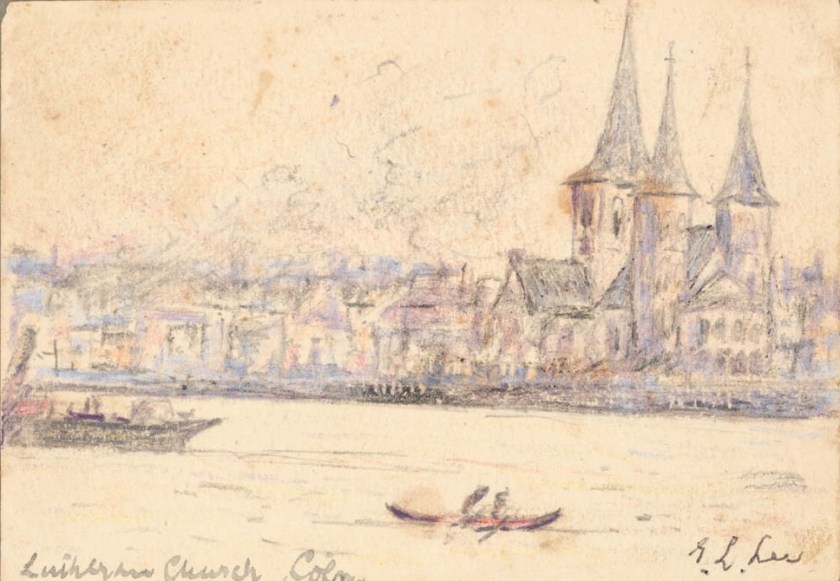
J. and I sat on the banks of the Rhine, and drew a large Lutheran church across the stream.

Met Hun skinflint, and received two seats for Tales of Hoffman, and brought in legitimate manner seats for Thursday’s performance – Jenufa, by one Janacek – and then cantered upstairs to hear Der Frieshutz.  It was unintelligible to us as drama, but we enjoyed much of the music.  It comprised supernatural elements – His Satanic Majesty – appearing – re-appearing and disappearing with accommodating frequency and promptitude, amid surroundings of Dantesque gruesomeness: in fact, at one stage of the proceedings brimstone and treacle were flying about in all directions.  It is a long opera, interspersed with much unaccompanied conversation, during which we Englanders were out of the joke, but several of the hunting scenes and interiors were beautifully staged, and the singing left little to be desired.  It contained two very familiar airs.

Returned to barracks, I am enjoying a second musical treat – a mouth organ!

Now used to counting our money in marks.  The trouble is that it fluctuates from day to day, like the Rhine with the rains.

sketch by lincoln lee - lutheran church, cologne, 11 jan 1919

[Image: Sketch of Lutheran church across Rhine, Cologne, by Lincoln Lee, 11 January 1919]

10th January (1919)

Morning taken up with the General’s inspection to accompaniment of an infernal band playing some hurdy-gurdy tunes ad nauseam.

Bedtime: I found the wily old man who had sold me my ticket, waiting to escort me to the seat next his own.  He was rather a nuisance during the performance, nudging me at the entry of the characters, and insisting on lending me his useless opera glasses.  Cavalieria Rusticana was very well staged.  It was followed by Leoncavallo’s Bajazzo, another two-act piece.  Thought I had heard neither in its entirety before, I cannot say these Italian Operas appeal to me so much as the German.

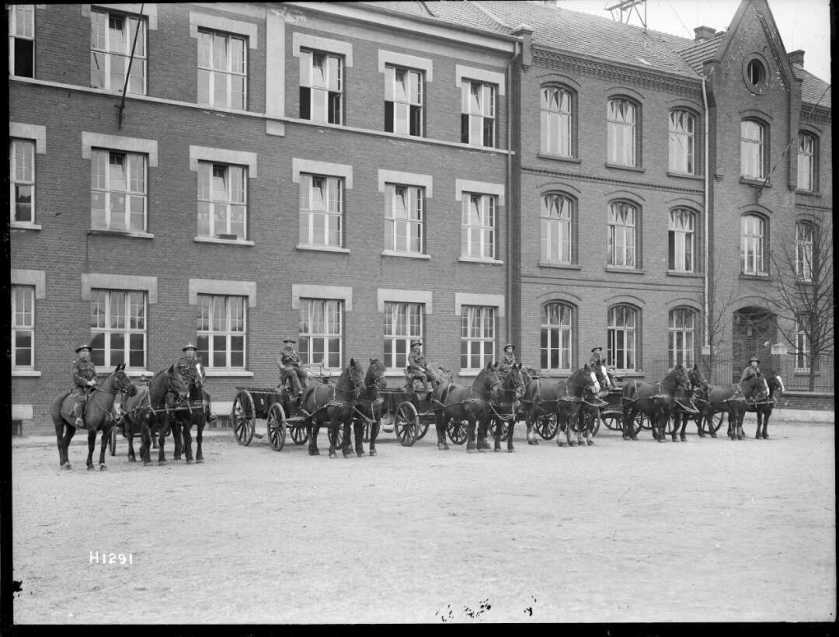
nlnzimage 1-1 002108-g nz horse transport, hq building leverkusen, jan 1919

[Image: The horse transport of the New Zealand Division lined up outside the headquarters building in Leverkusen during the occupation of Germany after World War I. Photograph taken January 1919 by Henry Armytage Sanders. Alexander Turnbull Library, Wellington.  Ref: 1/1-002108-G]

Donnerstag (9 January 1919)

Well, if they won’t demobilise me I’ll go to operas!  I remember reading about a German composer who was so fond of the old English air “The Last Rose of Summer”, that he introduced it into one of his works.  I little thought I should ever hear that work, and in Germany.  This opera seems to me to be in the same category as, say, the Yeomen of the Guard – comic opera verging on grand opera.  The music has often the full-bodied and almost obstreperous quality for which I have a weakness.

Mittwock, 8th (January 1919)

J. and I had a look round the museum in which are a large number of big oils, historical and ecclesiastic.  Also florid landscapes with a sprinkling of really charming things in portraiture, animal life etc.  The most entertaining room was devoted to modern stuff, including some quite insane futuristic efforts in colours so crude as to be downright repellent, others of a strength and boldness arresting in their cleverness.

Mozart’s comic opera, Figaro’s Hochzeit, delighted me with its characteristic Mozartian repetitions and cadences.  The prima donna possessed a beautiful elastic soprano.

7th January (1919)

The little ass who used to get tight and sing for hours at Souastre came in last night and wrecked the home – he accused the panes in the door of being “bloody square heads”, and drove his foot through three of them: then vented his patriotism on the coal scuttle and other inanimate objects.  Sleep was scarce.

Suntag (5th January 1919)

Passes are now issued for Cologne.  Forgetting to obtain one from the orderly toom, I manufactured quite a fine one myself.  After J. picked me up, and we made off in the hopes of obtaining tickets.  Old woman had sold out.  Eventually got J. in by succession of brazen rushes.  There were two dragons to quell, one at the grand entrance, and another at the tip-top, “the Gods”.  I dragged my scandalised comrade helter skelter into the melee.  We obtained (no more than our deserts) the worst seats in the house, about 100 yards from the stage, yet the music was quite audible.  As amiable Fraulein insisted upon our almost monopolising her opera glasses.  Rigoletto is easy tuneful music after Wagner.  The opera, as you will see from the programme which I enclose, was followed by half a dozen beautiful ballets to the music of Chopin, Schubert etc., played on the piano.  Each was done to separate scenic effect, the draperies of the dancers being decidedly diaphanous.

Samtag, 4th (January 1919)

What a surprise this Rhine climate has been – the people say it hardly ever snows.  Not being myself, I saw Dr., and he has given me orders to starve and keep quiet.  I have been treated to a delicious draught of castor oil, and have a box of pills for future reference.

9 p.m.  Back from the Flying Dutchman.  Being seedy and sitting next to a Canadian ass who made long remarks in the midst of the performance, I could not give it my best attention.  The scenery in the first and third acts was amazing and, the music was no means behind it; tremendous bursts and crashings upon the unready ear, weird winding undercurrents of meaningful harmony – delightful and unexpected melodies – all Wagnerian, yet with an element of immaturity.  One requires several hearings to properly appreciate these works.

Frietag (3rd January 1919)

My horses were both crocked by the trek.  I have not one in “Debility” stable, Chum, and poor old Dick in the Sick Lines, a lame bag of bones standing stiffly with his foot in a sand bag.  War they could put up with; peace proved too strenuous.

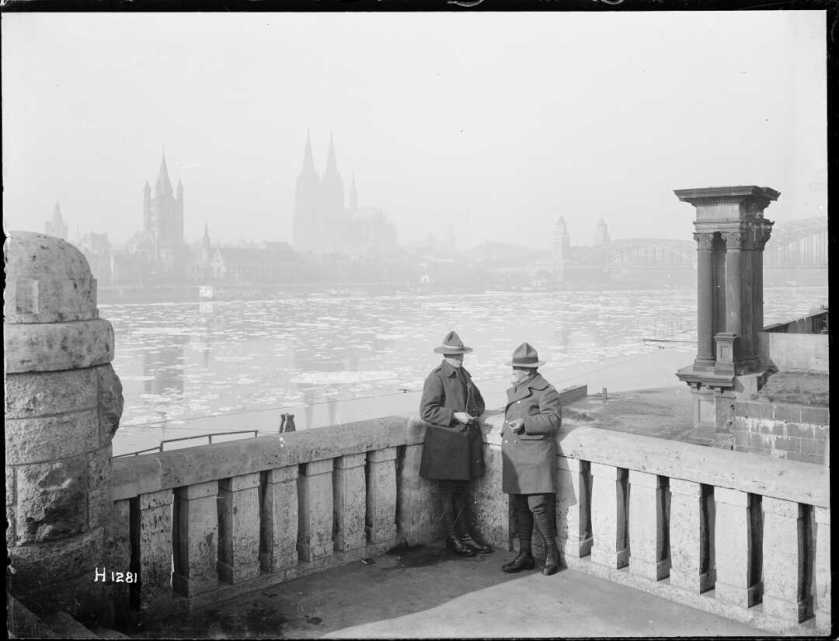
The Cathedral, the bridge and the encircling river are all in a tone of misty blue – the twin beauteous towers of the great building search up into a grey motionless sky.

Tonight’s performance of the Taming of the Shrew was far from disappointing.  Again the staging was sumptuous.  Katherine and Petruccio both possessed splendid voices, the former a fierce soprano, and the latter tenor robusto, and their acting was good.  It was a joy to know the plot and entendre of the thing.  The final duet at the reconciliation was only one of several very beautiful passages, and there were scores of supernumeries for the choruses.  Unfortunately I had a seat next to some Australians, who knew no better than to talk and guffaw most of the time.  The Southern Hemisphere begets some queer things in her attempt at man-moulding.  The Germans detest any interruption in their entertainments, and there I am one with them.

nlnzimage 1-1 002099-G NZ troops on leave in Cologne, by Rhine, Jan 1919

[Image: Two New Zealand soldiers on leave in Cologne, Germany, after World War I. Shows uniformed men by the Rhine with the city in the background. Prominent are Cologne Cathedral and the Hohenzollern Bridge. Ice is floating on the river. Photograph taken January 1919 by Henry Armytage Sanders. Alexander Turnbull Library, Wellington. Ref: 1/1-002099-G]