Saturday, 28th September (1918)

No sooner had we lunched (in a heavy shower) than Boot and Saddle sounded.  We booted and saddled.  The Hun is again on the run.  We have moved the guns a long way forward.  Our country torn and blasted in a horrible manner, though not many dead about.  In the distance we glimpse the towers of Cambri which, rumour hath it, we have already invested and taken.

Groups of prisoners pass us on the roads, often carrying their own and our wounded.  One place, the remains of a noble estate; every tree stripped almost entirely of leaves and shattered from root to top.  A heap of battered plinths shows where a stately gateway stood; everything in utter and hideous ruin.

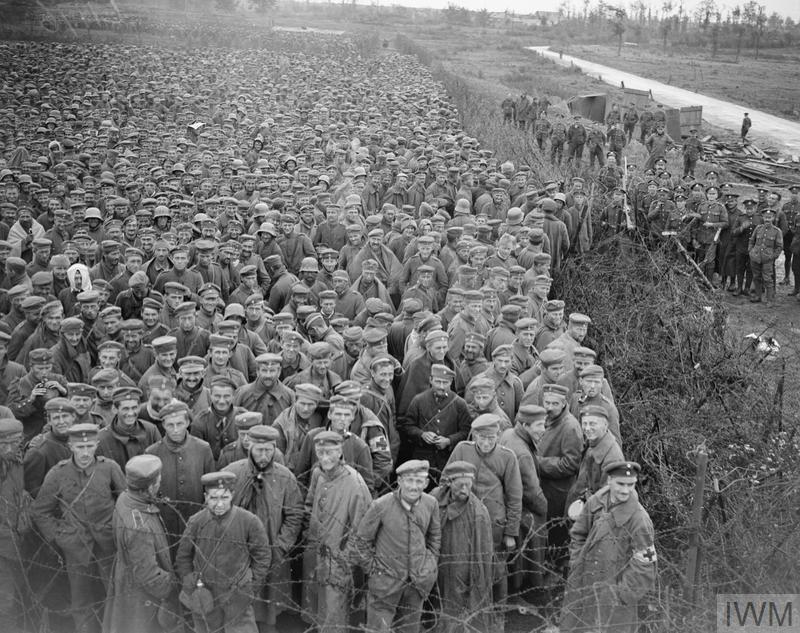
IWM (Q 9343) Prisoners captured in Battle of Canal du Nord, near Bapaume, 28 Sep 1918

[Image: Prisoners captured in the Battle of the Canal du Nord in a ‘cage’ near Bapaume, 28th September 1918.  IWM (Q 9343)]

Friday, 27th September (1918)

Midnight – underground in a little dug-out all to myself.  Another push is in progress and this morning we moved our wagon lines forward a couple of miles.  On prying around we discovered many little dug-outs and appropriated them.  As usual, with night the real day’s work began.  Dark and overcast; the bosche did not molest us.

IWM (Q 9335) Canadian battery advancing, Moeuvres, 27 Sep 1918

[Image: Battle of the Canal du Nord. A Canadian 18 pounder battery going through a cutting in the Canal du Nord, Moeuvres, 27th September 1918. Note the tank tracks and camouflage netting packed onto the guns. IWM (Q 9335).  Note, Moeuvres is immediately north of where the NZ Division was then deployed.]

Thursday, 26th September (1918)

Lived yesterday in the hopes of a night’s sleep but it wasn’t to be.  Night trip with a special shell.  Had things gone smoothly we should have been back before midnight, but exasperating delays occurred.  I can tell you there was some hard driving on the way back.  To bed at 2 a.m.  This waning moon fascinates me.  Last night it wore an almost insane and taunting expression and seemed suggestive of universal topsy-turvy don – I know this must sound very mad.  Often one sees a stream of “tracer” (luminous) bullets flying through the air, sweeping the night and catching a plane here and there, remaining on it a moment to make sure it is one of our own, is worth watching.

The animals are now grazing in bright sunshine; they, poor brutes, get the hardest work and little enough feed and are beginning to fall off noticeably.

Cloudlets in large droves, pasturing in the heavens – to use a Shellean metaphor – all being brightened by the hope of a night’s rest.

The air grows chill; the windy incantations of the wild Scot are plaintive on the moors, and darkness covers this ancient land of France and big events methinks are impending.

Wednesday, 25th September (1918)

Nocturnal disturbance in the nature of returning teams, prolonged shelling of a dump and the final and not to be ignored disturbance of being called out on picquet.  After lighting the cook-house fire we exacted toll in the shape of a cup of hot tea and an impromptu sandwich from a crust and a old ham-bone left there.  Two Tommies crept in and warmed themselves, after passing a lively night in the shelled dump, the tea loosening their tongues.

Saturday, 21st September (1918)

Toby is not a bad old cuss; he lets me pull him along by the ear when we are riding and he charges the fussy new officers, with bared teeth.  When hungry, he goes thro’ the motions of eating, vehemently.

Interrupted by the z-z-z-z-zwing! of a “tout suite.”  The Hohenzollern kept this up at regular 5 minute intervals for about an hour, all the shells landing in the same place; with his usual super-mathematical accuracy which saves many lives.  Towards dusk, in a deep blue-purple sky, behind shell-stripped trees, a monstrous globe of red-orange represents what in happier lands would be the “harvest moon.”  I cannot welcome her, for the sky is clear, but wish that, after delivering her message of good cheer from the far antipodes, she would retire behind some impenetrable camouflage of cloud.

Here comes ‘Jerry’.  Lights Out!

Friday, 20th September (1918)

A “Rest”.  Regimental stunt – several brand new officers on the scene – muster parade – shaved, washed, boots clean, buttons, teeth and toe-nails polished etc.  Although we have had only half a day of it we are beginning to wish we were in action again.  Perhaps that is the real reason they persecute one with their Tommy rot.

Much amused yesterday to see a bevy of very young Tommy officers fresh from the training school – brand new equipment – smooth, hairless, pink and white countenances – dumped by the wayside and looking so like lost lamps that one expected them to bleat.

I want another N.Z. mail.  I also want the war to finish tomorrow.  No, tonight, before Fritz starts bombing.  I want to go home.  J’ai froid; Je vais m’accoucher.

Wednesday, 18th September (1918)

6 p.m.  Saw a great deal of shell-fire going on up forward.  Passed a batch of prisoners.  One of the new drivers, quite a boy, came back from the guns gassed and was sent off to hospital; been here one day, and a casualty.  And here am I, a “veteran” of 11 months, unscathed and never had my gas mask on in earnest.

Have just completed a prodigal repast – tinned peaches and condensed milk, procured at hair-raising cost from canteen, the manager having made a two day trip to get them.

Midnight: A nice boy out of the reinforcements helped me to harness.  On the way we could see a heavy bombardment from our side, spattering along the horizon in almost regular rotation, suggestive of one of Bach’s Fugues.

Omitted several important items yesterday.  (1) Wasp stung me on the chest (2) washed 2 pair of sox in water intended for cleaning harness.  (The trumpet sounds!)

Opened the Bible I have had all along, and read Book of Ruth and the Song of Solomon.

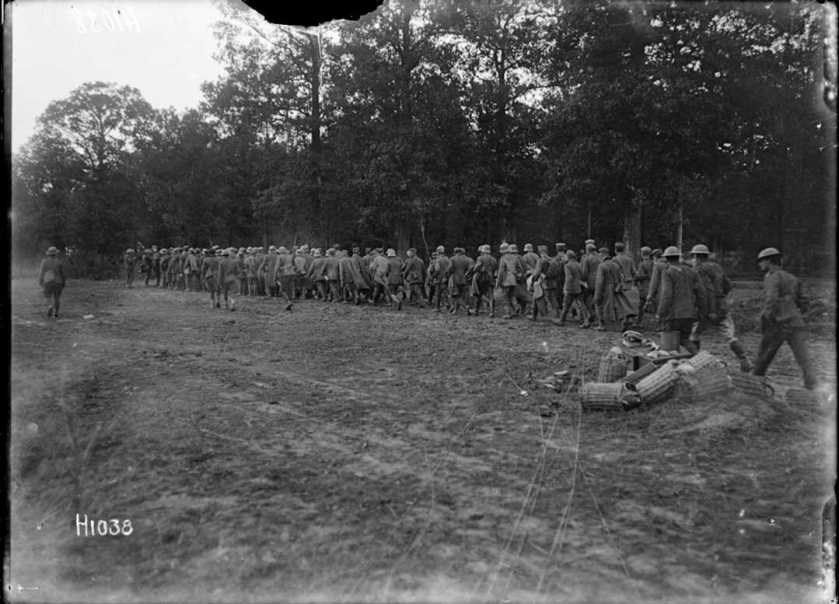
nlnzimage 1-2 013603-G German prisoners passing Havrincourt Wood, 16 Sep 1918

[Image: A column of German prisoners of war from the Jaeger Regiment passing Havrincourt Wood in France during World War I. They are escorted by New Zealand soldiers. Photograph taken 16 September 1918 by Henry Armytage Sanders. Alexander Turnbull Library, Wellington. Ref: 1/2-013603-G]

Tuesday, 17th September (1918)

Towards midnight our gunners turned up and got us well awake with banter, rummaging for biscuits, and general hilarity.  The Hun availing himself of moonlight besprinkled the whole countryside with bombs, one string of them running towards us with a tremendous crescendo.  Later, we awoke to the most infernal din ever heard.  In our dazed state some thought a bomb had hit our hut, others had visions of the end of the world – run-away railway trains etc.  To me it seemed that bombs, highly luminous, were bursting over my bed.  Then the hut started to bulge and quiver; gusts of air, water laden, came squirting in at every cranny and we were in the middle of a cataclysmic electrical disturbance.  The whirlwind which had preceded it had, we discovered this morning, snapped off a large tree behind our hut and thrown it across a shack nearby.

Now that there is some possibility of Germany being beaten, one begins more than ever to speculate about getting through safely.  It will be very hard luck for those who fall during the closing days of the war.  Still more reinforcements arrived tonight.

11 p.m.  At dusk, ordered out with ammunition.  The Hun, taking advantage of the clair de lune was bombing heavily.  He struck a large dump, exploding ammunition with a vivid, incandescent glow, lighting up the country for miles around.  After we left our guns, bombs commenced to fall behind us and to flank unpleasantly near.  We dismounted for a while and covered under a bank, then away at a hard-gallop.  Before getting into bed we had the satisfaction of seeing one of the raiders crashing in flames and finally exploding, with an immense blaze of bombs and petrol, in mid-air.  Annoyed Irish mate by lighting cigarette during bombing.  “Lee,” he said, “you are a bloody fool – I have no love for the grave.”

Monday, 16th September (1918)

Glorious morning after a night of bombs.  Sweet September restored.  One bomber was brought down in dramatic fashion by one of our planes which pounced from above, through our own barrage.  A howl of jubilation from the picquet and sundry hop-out-of-bed enthusiastically-exclaimed his fall.  Reinforcements arrived today and we carry on.

Cogitating the hard history of herbivorous and gramivorous animals hampered in their evolution by the unremitting pangs of hunger due to the little nourishment in their food.  Under different conditions they might have excelled man-the-monkey.  Their ideas are confined to food.  If you use a wisp of hay to wipe the slush from their fetlocks, you face an apparition of glaring orbs and protended lips, groping for the filthy handful which you then employ as a sort of boxing glove against their astonished probosci-ae-a-es (or) –oscises – whichever be the plural of that singular word.

Reinforcements arrived, squatting on the grass attacking bully and biscuits and trying to look like veterans.  The plane brought down last night was a six seater – all were killed.

Sitting on a broken tombstone, near what remains of a village church.  The ground is strewn with shattered crucifixes and gaping tombs, rank grass grows over all.  At the bottom of the tomb I saw a young toad, caught by one toe under a piece of a fallen slate.  I couldn’t get down and had a risk of liberating his death – by dropping bits of stone on the slate, until it shifted and he crept off.