Saturday, 8th June (1918)

Informed that I was transferred to another ward in the Chateau, to find they had no diet for me.  Befriended the staff and got a feed of spuds, gravy and rice custard.  After that got my gear and was again proceeding to the Chateau when sent back again with orders to transfer there again.  So “I don’t know where I are” (In announcing at a village concert the comic song “He don’t know where he are” the local parson put it – “Mr. … will now sing “He does not know where he is”).

Here I am at the Chateau, sitting under a tree, listening to the birds singing, to the village church bell ringing good Catholics to mass, and awaiting the inspecting officer – I take a fiendish delight in placing military considerations last.

Did a drawing of the Chateau, thinking it would interest you as giving an idea of the type of building.

Have also written to sister Myrtle appraising her of my recent adventures in thunder-land.  The orderly called me to go and get my medicine and I went off with visions of some flowing libation effervescing in a crystal goblet, but was handed instead the most insignificant little white pill.

nlnzimage 1-2 013723-G NZ Divisional Headquarters in Louvencourt, 30 April 1918

[It is possible Lincoln was referring to this building as the ‘Chateau’.  Image: A general view of the New Zealand Divisional Headquarters in Louvencourt, France for part of 1918, World War I. Shows a large country house at the end of a curving drive. Photograph taken 30 April 1918 by Henry Armytage Sanders. Alexander Turnbull Library, Wellington.  Ref: 1/2-013723-G]
Friday, 7th June (1918)

No reveille and breakfast in bed!  This will “do” me.  Having my little Shelly with me I have just re-read “that radiant fantasy The Witch of Atlas.”

They have put me on a milk diet which I’ve contrived to augment by a slice of bread and butter.  After tea strolled around to J’s quarters and spent about an hour with him.  Some subterranean tunnels have one of their openings near by.  J took me down a flight of steps about 100 ft. and we walked a little distance along them lighting our way with candles.  They have apparently existed for hundreds of years and have bewildering ramifications all over (or rather under) the village and have lately been explored for military purposes.  No one seems to know what they were made for, unless for refugees in time of invasion.

Thursday, 6th June (1918) – Louvencourt

“Your humble” finds himself in another place and in another capacity.  The complaint from which I have been suffering for the past week still continuing, the medical humourist packed me off to a rest-hospital in the next village.  After protracted delays, I found myself here in a large room which appears to have been a school, its walls being still embellished with 2 maps of the world (“Mappemonde”), a long rigmarole in easy French headed “Declaration des droits de l’homme et du Citoyen”, and a chart showing in lurid lines the effect of alcohol on the internal organs, intituled “L’alcool, viola l’ennemi.”

Here I lie with 20 other convalescent-looking soldiers, awaiting the result of a third dose of castor oil and chlorodyne* during the past few days.

* An pain-relieving medicine with a minty taste; active ingredients of opium, cannabis and chloroform.

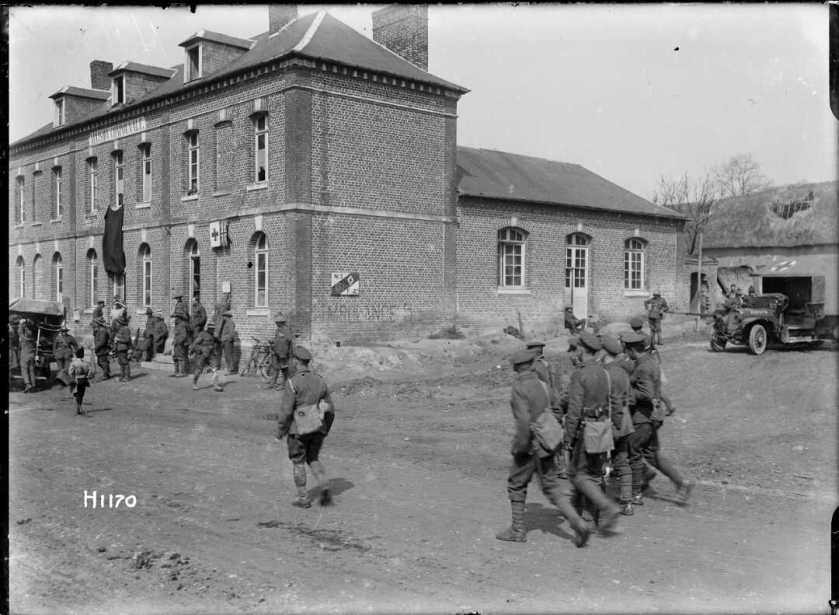
nlnzimage 1-2 013718-G Field Ambulance at Louvencourt, 22 April 1918

[Image: A general view of a New Zealand Field Ambulance at Louvencourt, France in World War I. Several soldiers are standing around the entrance of the large brick building. A small Red Cross and a Union Jack hang by the door. A group of soldiers is walking past. An ambulance is parked in the background. Photograph taken 22 April 1918 by Henry Armytage Sanders. Alexander Turnbull Library, Wellington. Ref: 1/2-013718-G]

5th June (1918)

Spent all last evening digging the floor of the bivvy down and making a small earth ramp round the outside to comply with orders.  The most you can do is to make yourself safe from splinters whilst sleeping.

4th June (1918)

The noise of hundreds of shells bursting heard from two or three miles away, is a most peculiar and sinister one.  It’s rhythm keeps varying; it has a crumbling, chattering, gibbering, crunch, crunch, mumble, mumble, effect, that I can only describe as wicked.  We have orders now to dig in and make our bivvies  bomb-splinter proof.

Went to the mad “quack” today to get some pills; he really is most amusing and sometimes quite witty – whatever you say he contrives to trip you up.

3rd June (1918)

Made myself a fantastic preparation of milk custard for lunch, burning my fingers and capsizing half of the curdled-looking result.  I buy milk from “Joan”; our conversation is always the same – “Bon Jour Madame – du lait?”  “Oui M’sieur” and off she toddles down a flight of steps into the cool bowels of the earth – whilst Darby blinks rheumy-eyed by the fire.  She reappears with a basin, fills a small jug and says “voila”.  I take it, and hand her a quarter sous (2d.) – “Merci Madam” – “Merci M’sieur” – “B’jour”, “B’jour”.

Sunday, 2nd June (1918)

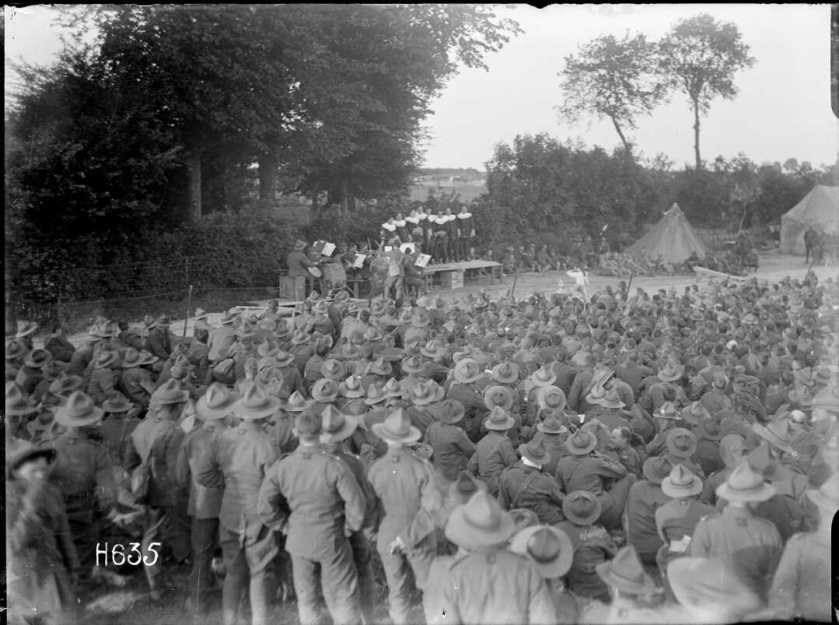
We won the contest and the teams go to the ‘show-grounds’ tomorrow, but I’m not going with them, being a bit off colour.  My indisposition is of a kind that makes it awkward to be on parade.

nlnzimage 1-2 013242-G Army entertainment troupe playing to NZers, Louvencourt, 3 June 1918

[What Lincoln might have missed out the next day, had he visited the ‘show-grounds’, rather than been indisposed by dysentery.  Image: A general view looking over the audience towards the army entertainment troupe the Kiwis and their accompanying orchestra who are playing for New Zealand troops in an evening performance. Photograph taken Louvencourt 3 June 1918 by Henry Armytage Sanders. Alexander Turnbull Library, Wellington, Ref: 1/2-013242-G]

31st May (1918)

All madly scrubbing and rubbing up bits of harnesses for Sunday’s inspection, when the smartest battery will be chosen to represent N.Z.F.Z at the coming show.  Dawson has actually cleaned his buttons and is using one as a mirror whilst brushing his hair.  The mules have been on short commons and are beginning to cast indignant and malignant glances behind them and eat more rope.

30th May (1918)

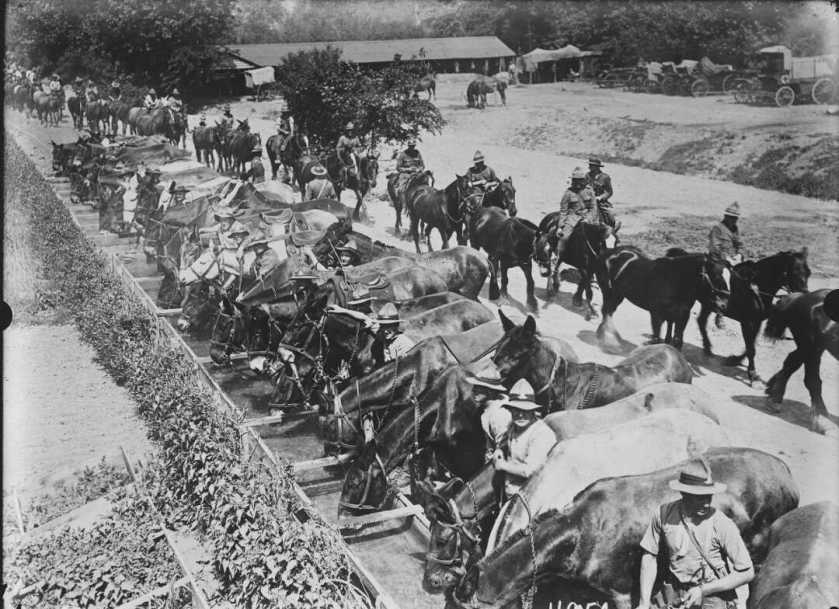
Had to wait an infernal time in the sun for the water troughs, so I lay back on the mad mare’s back and must have gone to sleep, for when some idiot scared her I was rudely awakened by falling with a fearful bump on my nether and in the dust, to the huge delight of the bystanders.

nlnzimage 1-2 013260-G Watering point, Lovencourt, 1 June 1918

[Image: New Zealand horses and troops at a watering point in Louvencourt, France, during World War 1. Shows a row of horses at a drinking trough and a procession of others behind them. Photograph taken 1 June 1918, by Henry Armytage Sanders. Alexander Turnbull Library, Wellington, Ref: 1/2-013260-G]

Sunday, 26th (May 1918)

In the evening we made two journeys with ammunition.  Saw a dump blown up in the distance, lighting up the sky with an intense flame for a few seconds, accompanied by a dull roar.  Practising for the sports I had entered for the “mule hurdles” but as neither of my hybrids can now be tempted, coaxed, cajoled, beaten or tricked into taking the hurdles, I’ve given them up as a bad job.

IWM (Q 11473) Crater caused by explosion of British ammunition dump at Wardrecques, 19 May 1918

[Image: Crater caused by the explosion of a British ammunition dump at Wardrecques, 19 May 1918. IWM (Q 11473)  Note – this is not the area where Lincoln is deployed]

IWM (Q 11472) Destruction caused by explosion of British ammunition dump Wardrecques, 19 May 1918

[Image: Destruction caused by the explosion of a British ammunition dump at Wardrecques, 19 May 1918. IWM (Q 11472)]